Showing posts with label artist. Show all posts

26 November 2015

/APT8/ The 8th Asia Pacific Triennial at the Qld Gallery of Modern Art


Words: Saskia Edwards 
Images: Jonathan Rae

“One thing that was really apparent to me and also very beautiful were the amount of saffron robes.

“It was almost as if the landscape was orange, that you couldn’t go to any parts of South East Asia without seeing this colour orange in your periphery and in your vision.”

That’s according to Cambodian-born American artist Anida Yoeu Ali, who’s described as one of the ‘rockstars’ of the APT8.

Her work at the exhibition centres on Cambodia as she takes on the persona of the Buddhist Bug.

Anida Yoeu Ali dresses as the Buddhist Bug in a long spiraling tube with feet sprouting out at its tail end. It’s somewhat Alice in Woderlandian - like the blue caterpillar. Of course, the fabric is that same vivid saffron that’s so evocative of Asia, Cambodia and Buddhism.

While being distinctly Buddhist, the bug also wears a sort-of hijab. As Anida says, it references the “Islam that my parents carried back to the U.S. with them that they preserved for me and then my rediscovery of Cambodian Buddhism”.

Anida left Cambodia when she was five years old. She lived through the Khmer Rouge, a period of Communist rule in Cambodia remembered for genocide. And this has resulted in dysphoria for Anida, with her life riddled with “war and the displacement and the refugee identity”.

However, Anida is not dwelling on the past.

“I felt this very palpable energy among my colleagues among the artist community in which there felt like a critical mass in which the artist community was finally addressing the present moment and not just locked in the time, in referencing the past, the past trauma. 

“So to me it was a really exciting part and I knew we had something special that intersected with the reign of progress and modernisation and urbanisation that’s happening at a tremendous rate in Cambodia while the level of poverty increased.”

Beyond a performance piece dressed as the Buddhist Bug, Anida presented a film as part of the exhibition. It follows the bug for a night in Phnom Penh.

She begins at a carnival where the rides drench her in neon light. And then she rides around the busy streets of the city, her head poking through the roof of a took-took. She goes past a market and to a nightclub. There she finds young Cambodian women - some “empowered”, others not - dancing in mini skirts and tank tops with old white men.

All of this captures something very elemental and visceral about Cambodia. On one hand it seems to show the progression of Cambodia and how it has been thrust into the luminous modern world. But also it reveals how the nation is still growing. People are still largely on bikes and scooters. There’s an insidious invasion of Western culture. And, in a way, it still has that wild untamed beauty of Asia - where food is cooked on the side of the road, traffic is monstrous and anything could happen.

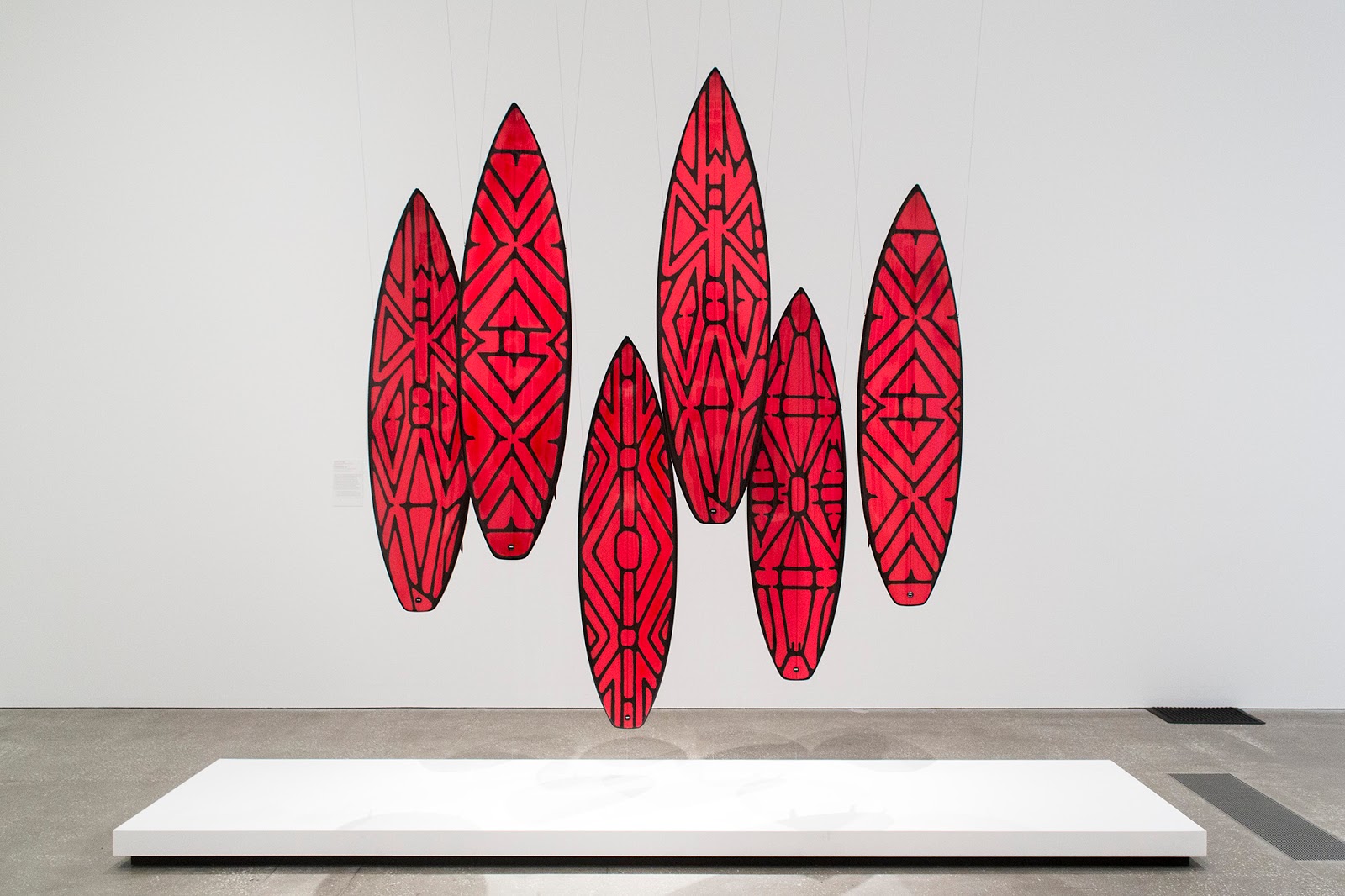
As a whole, APT8 has a great focus on the Pacific. There’s an abundance of oceanic art. Often, it’s in a contemporary style, with live tattooing, performance art and photography. But it’s all weaved together with traditional icons. Plus, on the opening weekend there were a few people in ethnic dress - often part of installations - wandering around the gallery.


Of course, there’s more at APT8 than a person can really absorb. But take time, it’s worth it.


8 November 2015

Niqui Toldi’s Unbeing exhibition at Junky Comics: girls and anxiety


Words: Saskia Edwards
Images: Jonathan Rae

In Niqui Toldi’s illustrations there’re lots of girls - short hair, long hair, smoking, angry, pierced, bound.

But really, all these girls are Niqui. They’re like a self-portrait - a manifestation of how she feels and is. And they’re a way of grappling with her own life and self-identity. 

She says: “it’s just sort of a way for me to deal with how I’m feeling internally because I’m not always good at externalising how I feel to other people.

“It’s sort of a way for me to separate myself from being too vulnerable at the same time. It’s being vulnerable but without being completely vulnerable.

“Because it’s not always necessarily completely obvious that they are almost me.”

The girls seem sad at times, self-destructive, lost, with hands anxiously clasping at the ground or onto a cigarette or a match or a scalpel. And they do really display anxiety quite well - where nothing bad is happening immediately but you’re trapped sitting there half naked smoking and feeling helpless with a whirlwind in your brain.

This ‘Unbeing’ series looks at the last year of Niqui’s life. 

“A lot of things happened - a relationship I had of four years had just ended, my grandmother who lives alone and I’m her only blood relative... had a stroke so I’m her main contact.

“Then I was getting more responsibilities at work and it was the first year I’d been medicated and properly diagnosed for my anxiety.

“So it was a huge collection of all these things happening in the one year.

“I just started to deal with it - started drawing it.”

But it’s not that easy. Putting on a solo exhibition was a big deal for Niqui. 

“Because of my anxious nature and shyness I’ve always been really reluctant and I almost hold myself back.

“So this is the first time that I’ve really let myself put myself out there.

“Even last night at the launch, it was exciting and I was nervous and people had started coming in.

“And maybe five people had come in that I didn’t know and I just started crying up the back, which is really ridiculous because this is a really good thing, this is a fun time.”

Of course it went really well. People sardined themselves into Junky Comics, admiring what I guess they thought were imaginary sirens. 


If you really think about it, Niqui’s works remind you of the true purpose of art. They show that out of anxiety, self-doubt and heart ache you can make something. And it can be beautiful.


7 September 2015

Robert MacPherson 'The Painter's Reach' at GOMA


Words: Saskia Edwards
Images: Jonathan Rae

At times while walking through Robert MacPherson’s ‘The Painter’s Reach’ show, you feel like you could be at your local grocer, or driving through a small town somewhere like the Granite Belt. 

The exhibition revels in the everyday. There’re signs with mundane and sometimes surreal messages splashed onto them - always in the bold, imposing and rusticated style of MacPherson. Many of the works have a dry, rough feeling about them, much like the nature of processed wood and some of Australia’s landscape. And objects of everyday life are celebrated like benches, shirts, dry cleaning.

More than 40 years of MacPherson’s career is explored in this retrospective. It looks at his process, obsession with the medium of paint and social commentary. That includes a reflection on the history of “miracle drug” M & B 693 to treat gonorrhoea.


But throughout Robert MacPherson’s works there seems to be something inherently, and evocatively Australian. Each of his works conjure up a memory, understanding and distinct feeling of what Australian life is.


23 August 2015

Contemporary Queensland Artists at GOMA Q: Spotlight on Sam Cranstoun


Words: Saskia Edwards
Images: Jonathan Rae

Lord Louis Mountbatten - the cousin of the Queen - was responsible for funding an affordable braille typewriter, developing a particular shade of pink and was a supporter of a military ship made from ice and wood pulp. 

Then, in 1979, he was assassinated by the IRA. They blew up a fishing boat he and was aboard off the coast of the Irish town Mullaghmore.

Sam Cranstoun remembers this quizzical and benevolent royal in his works at GOMA Q. 

“I came across this figure Mountbatten who was connected to the British royal family, but also connected to the Russian royal family.

“All of these little stories kept presenting themselves and they were just increasingly fascinating.

Perhaps Mountbatten was also motivated to think up these schemes by a desire to prove his relevance as a royal. It was an era where the divine rights of the monarchy were being questioned. Hence it’s possible that Mountbatten was attempting to justify his position through, somewhat misguided, ingenuity.

“He really was clearly striving to do good things. They were incredibly earnest.

“A lot of them were quite ridiculous and outlandish, but they were all really based in fascination with innovation, but also by having a military edge.”

Sam’s exploration of the Mountbatten narrative manifested itself in three ways. Firstly, a flag dipped in Mountbatten pink - a mauve hue he thought would be an effective camouflaging colour for the military (but was probably a bit too fabulous). Secondly, a canvas punched with braille. It reads “remember in spite of everything he was a great man”.

“There was a biographer that was writing the official Mountbatten biography and he did exhaustive research through his archives and work with him directly.

“And apparently Mount Batten had quite a flair for exaggerating his role in history.

“This biographer, his whole life was made exceedingly difficult by the fact that we would hear the story and find out the story from Mountbatten and then would have to perform more research to actually determine if that was actually true or not that was an incredibly frustrating for him.

“To the point where he actually made a plaque that was his own personal mantra that said, ‘remember in spite of everything he was a great man’.”

And finally, a film. Sam travelled to Mullaghmore, the site of Mountbatten’s murder, to trace his final days and examine the scar the event left on the town.

“It’s fair enough and it’s justifiable and understandable that they [the IRA] wanted their own country and that they wanted to take it back for themselves.

“But then the way they went about doing it was so morally bankrupt it was so wrong, the way that they would kill innocent people just to bring attention to their cause.”

“I was interested in how my relationship with the story would actually change by visiting Mullahgmore.

“One of the things that I thought would be an interesting activity while I was there was to actually go out in a boat and see the waters that he would have seen everyday and seen while he was killed.”

The video is quite soft and placid - it follows the rolling landscape of Mullaghmore - that is often interrupted by the monolithic Classiebawn Castle. And there always seems to be a faint serene wind. But it’s like the town has a thin film of serenity enveloping a much greater turmoil.

Sam contacted a charter boat company about taking a trip around the idyllic peninsula. They couldn’t take him, but the operator actually knew Mountbatten. In fact, she maintained his boat for a decade and was familiar with him. Sam spoke to her over two days about the assassination, Mountbatten and how the event has shaped the town. It was, quite obviously, an emotionally charged issue for her - with her regularly breaking down during the interview.

“I was very aware that clearly this isn’t something that has just disappeared and it wasn’t just going to disappear – it was a story that was forever linked to the town.

“I knew it was something that preoccupied her quite a lot, but I didn’t expect her to be quite as emotional as she was.”

Sam’s series was quite sombre. But simultaneously quite meditative. It shows, through a very specific window, how one person can become the epicentre of so many peripheral issues (modern royalty, the War of Independence, the military). And it shows how the waves of one person’s life have carved permanent grooves in many people’s minds. 

Here's some of the other works by contemporary Queensland artists on show at GOMA Q.


27 June 2015

Quaternary exhibition at QUT Art Museum


Words: Saskia Edwards
Images: Jonathan Rae
Artworks: Bianca Beetson, Chantal Fraser, Rachael Haynes, Natalya Hughes, Alice Lang, Gemma Smith, and Jemima Wyman

Bianca Beetson says “we were all born pink, even when a dark baby is born, it’s still pink at first”.

And it’s that colour, which is so deeply imbued with meaning, that underpins Bianca’s work.

“I was a bit of a tomboy growing up and my mother, I remember her, as a last ditch attempt putting me in this pink bedroom,” says Bianca.

“It had pink clouds on the wallpaper and on the bedspread. And I really don’t like the colour pink.

“I ended up reclaiming pink in many ways and my hatred for pink became about anger and how pink’s not necessarily this insipid colour that’s associated with girls it can actually be quite powerful.”

Bianca’s self portraits at QUT’s Quaternary exhibition are bathed in fuchsia, blush and coral. Her costume changes from soldier, to barbarian to bohemian. It’s kind of this strange journey of mercurial magenta identity. And Bianca’s wrestle with identity is inexplicably linked to her aboriginality that of course is steeped in complex history and politics. 

“I always struggled with this thing of, who am I? and being pigeon-holed and people expecting you to act and behave in a certain way.

“And I think back to my uni days and I’d turned up nearly every day dressed as a completely different person because just when someone had thought that they had got me figured out... where to put me, I would shift.”

The pink in Bianca’s practice extends beyond femininity and self-perception. It looks at the “artificiality” of Australian history and “the way that pink sort of signifies this candy-coating”.

“I talk about sugar-coating poo and you can even sugar-coat poo that much and make it palatable.

“And at the end of the day it’s still poo.

“‘Let’s cover it up, let’s sweeten it’, but the problem doesn’t go away.”

Bianca has looked even further into that richly emblematic colour and found the concept of assimilation. Bianca’s grandmother was a domestic in Cherbourg where she “was taught to be a good woman, a good cleaner, a good cook, to stitch and sow and do all of those domestic things”. For Bianca, this represents the assimilation of her culture, heritage in family.

In the end, history, gender, identity: they're not white washed, they're pink washed.


30 April 2015

Michael Parekowhai: The Promised Land at GOMA


Words: Saskia Edwards
Images: Jonathan Rae

What is the promised land?

It’s that milk and honey elysium. That prophesied paradise. And it’s something that’s written into our history, mythology and self perception.

You’ll find it at the end of 40 years of walking, at the end of the world, at the end of your life or in a new city, a new country, a new person. 

Over the last 26 years of practice Michael Parekowhai has navigated his way through through this idea and how deeply it streams through our sense of identity.

Maud Page is the Deputy Director of Collections and Exhibitions at GOMA and curator of Michael’s current exhibition there ‘The Promised Land’.

“You can look at that [the promised land] historically, you can look at it in terms of political terms now and there’s a lot of that kind of talk happening in political campaigns.

“But essentially, the promised land, because it looks back at history, it really is the way we might also remember our collective history and remember where we’ve come from.

“So for New Zealand and Australia that might encompass someone as famous and known as Captain Cook.”

And Captain Cook certainly acts as a centre piece for the exhibition. A three-metre tall stainless steel Cook sits in the middle of a room. The sculpture reflects the objects on the walls and as an observer, an image of yourself; distorted and warped in his own shape. And it forces the onlooker to meditate on how interwoven this person is with our own identities and perhaps, with a solemn look on Cook’s face, the reality of what attaining the promised land means.

Maud says through this piece Michael is “looking back at history and making a bit of a comment as to how we commemorate and what we commemorate and then looking at the ways we as individuals might be able to position ourselves in that history”.

Scale plays an integral role in the impact of Michael’s work. The sizes he chooses are no accident, they’re perfectly conceived to have the most impact.

“When you’re near it [the statue of Captain Cook], he’s sitting down, so you’re near it you’re almost awed by it but it’s not quite tall enough to be awed,” says Maud.

“And it’s not quite small enough for it to be an intimate relationship.

“So he just finds that exact middle ground.”

As you walk through the exhibition, Michael’s use of blank space is also apparent. He can make you feel like you’re compressed or claustrophobic walking through tight spaces or in a wide, open almost isolating expanse.

“He loves the sense that how we might breathe within the gallery, how we might physically encounter artworks and the effect that that scale has on us,” says Maud.

“So instead of being in his practice previously at a human scale, he might bring them right down to maquette size and create a completely different feeling.

“Or he might upsize some of the things that we’ve only ever seen very very small, like the small Cuisenaire rods that were used to teach kids or to teach Maori language in the late 70s and early 80s.”

Michael’s sculptures are also laced with a kind of humour - a sarcastic wit. You can see it in his elephant, tipped on its head, a seal holding up a piano and giant pick-up sticks at the foot of a ballerina.

“He is looking at colonialism, he is looking at social issues such as the employment of Maori people or the position of say Maori battalions in WWI and when they came back from the trenches back into New Zealand, what happened to them,” says Maud.

“So they’re things that are extremely visceral and very contested and the way that he brings humour into them means that he can actually make a comment on them, but also not appear too didactic, which is something that I particularly love in his practice.”


Through his shiny, playful and at times confronting sculpture Michael invites us to think about our sense of self and how that’s inseparably linked to the legend of the Promised Land.


11 January 2015

Sandra Selig and Vernon Ah Kee at Milani Gallery


Words: Saskia Edwards 
Photos: Jonathan Rae
Sculpture/Collage: Sandra Selig
Paintings: Vernon Ah Kee

Sandra Selig’s works look like interstellar origami - where planets, nature and fractals envelope each other.

The images are from outdated science textbooks. They have the quality of images in old atlases. Their treatment captures the 20th century. I mean the aesthetic has the colours and character of film photography particular to the 20th century.

“[I] find a lot of the images very moving,” says Sandra.

“I like that the text does not reflect that, so it leaves room for me to re-interpret.

“With the folded works, I like the unexpected pairings of images when you fold over a page that has an image on both sides.

“It has multi-dimensional play.”

The works seem like they’re still evolving. While delicately and purposefully arranged, they appear to be in a state of growth. I suppose much like the nature of the universe or our environment.

“I think it's interesting if the work doesn't completely know itself but is partially in a state of trying to do so. It's a puzzling soul, more like a garden.

“Changing in time, reaching for the sun, but also staying in the earth it was planted in.”

The NSW-born artist completed a Masters in Visual Arts at QUT in 1999. Sandra has exhibited internationally, notably in Britain and Japan. Her interests also extend to music as an active member of the underground Brisbane music landscape. Previously Sandra played in The Deadnotes and now she’s half of the lo-fi electronic band Primitive Motion. She’s combined the two mediums.

Sandra partnered with her bandmate Leighton Craig “on Visual Art/music hybrid projects”.

In March the duo will release their second LP to which the artwork will be integral and complementary. In the same month Sandra will exhibit two major installations - one at Sydney’s MCA and the other at the NGV in Melbourne.

Until then, take a look at Sandra’s latest works. They’re kind of calming, natural and nostalgic. 


Also at Milani Gallery but with a very different quality - Vernon Ah Kee’s paintings.


Above: Sculpture/Collage works by Sandra Selig


Above: Paintings by Vernon Ah Kee