Showing posts with label Queensland. Show all posts

23 August 2015

Contemporary Queensland Artists at GOMA Q: Spotlight on Sam Cranstoun


Words: Saskia Edwards
Images: Jonathan Rae

Lord Louis Mountbatten - the cousin of the Queen - was responsible for funding an affordable braille typewriter, developing a particular shade of pink and was a supporter of a military ship made from ice and wood pulp. 

Then, in 1979, he was assassinated by the IRA. They blew up a fishing boat he and was aboard off the coast of the Irish town Mullaghmore.

Sam Cranstoun remembers this quizzical and benevolent royal in his works at GOMA Q. 

“I came across this figure Mountbatten who was connected to the British royal family, but also connected to the Russian royal family.

“All of these little stories kept presenting themselves and they were just increasingly fascinating.

Perhaps Mountbatten was also motivated to think up these schemes by a desire to prove his relevance as a royal. It was an era where the divine rights of the monarchy were being questioned. Hence it’s possible that Mountbatten was attempting to justify his position through, somewhat misguided, ingenuity.

“He really was clearly striving to do good things. They were incredibly earnest.

“A lot of them were quite ridiculous and outlandish, but they were all really based in fascination with innovation, but also by having a military edge.”

Sam’s exploration of the Mountbatten narrative manifested itself in three ways. Firstly, a flag dipped in Mountbatten pink - a mauve hue he thought would be an effective camouflaging colour for the military (but was probably a bit too fabulous). Secondly, a canvas punched with braille. It reads “remember in spite of everything he was a great man”.

“There was a biographer that was writing the official Mountbatten biography and he did exhaustive research through his archives and work with him directly.

“And apparently Mount Batten had quite a flair for exaggerating his role in history.

“This biographer, his whole life was made exceedingly difficult by the fact that we would hear the story and find out the story from Mountbatten and then would have to perform more research to actually determine if that was actually true or not that was an incredibly frustrating for him.

“To the point where he actually made a plaque that was his own personal mantra that said, ‘remember in spite of everything he was a great man’.”

And finally, a film. Sam travelled to Mullaghmore, the site of Mountbatten’s murder, to trace his final days and examine the scar the event left on the town.

“It’s fair enough and it’s justifiable and understandable that they [the IRA] wanted their own country and that they wanted to take it back for themselves.

“But then the way they went about doing it was so morally bankrupt it was so wrong, the way that they would kill innocent people just to bring attention to their cause.”

“I was interested in how my relationship with the story would actually change by visiting Mullahgmore.

“One of the things that I thought would be an interesting activity while I was there was to actually go out in a boat and see the waters that he would have seen everyday and seen while he was killed.”

The video is quite soft and placid - it follows the rolling landscape of Mullaghmore - that is often interrupted by the monolithic Classiebawn Castle. And there always seems to be a faint serene wind. But it’s like the town has a thin film of serenity enveloping a much greater turmoil.

Sam contacted a charter boat company about taking a trip around the idyllic peninsula. They couldn’t take him, but the operator actually knew Mountbatten. In fact, she maintained his boat for a decade and was familiar with him. Sam spoke to her over two days about the assassination, Mountbatten and how the event has shaped the town. It was, quite obviously, an emotionally charged issue for her - with her regularly breaking down during the interview.

“I was very aware that clearly this isn’t something that has just disappeared and it wasn’t just going to disappear – it was a story that was forever linked to the town.

“I knew it was something that preoccupied her quite a lot, but I didn’t expect her to be quite as emotional as she was.”

Sam’s series was quite sombre. But simultaneously quite meditative. It shows, through a very specific window, how one person can become the epicentre of so many peripheral issues (modern royalty, the War of Independence, the military). And it shows how the waves of one person’s life have carved permanent grooves in many people’s minds. 

Here's some of the other works by contemporary Queensland artists on show at GOMA Q.


11 January 2015

Sandra Selig and Vernon Ah Kee at Milani Gallery


Words: Saskia Edwards 
Photos: Jonathan Rae
Sculpture/Collage: Sandra Selig
Paintings: Vernon Ah Kee

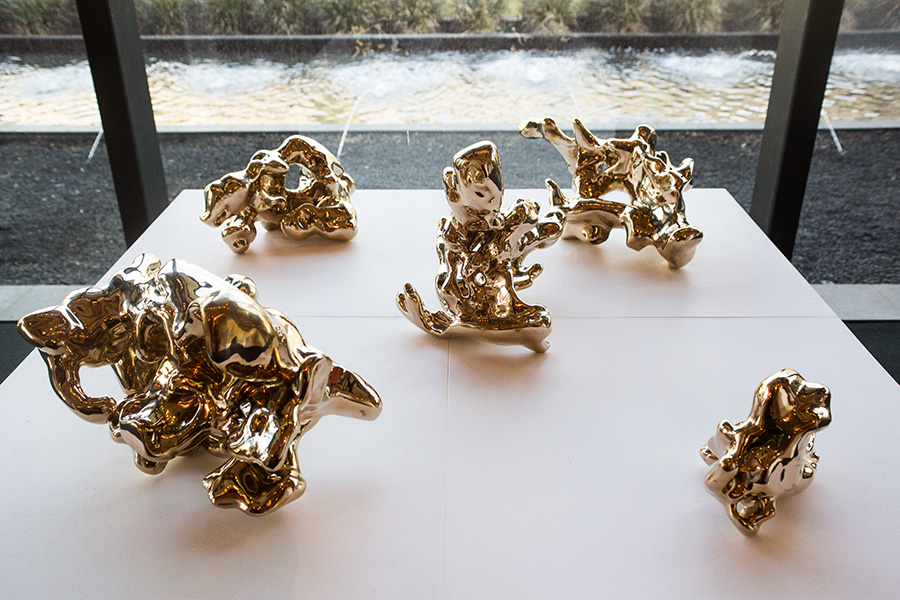
Sandra Selig’s works look like interstellar origami - where planets, nature and fractals envelope each other.

The images are from outdated science textbooks. They have the quality of images in old atlases. Their treatment captures the 20th century. I mean the aesthetic has the colours and character of film photography particular to the 20th century.

“[I] find a lot of the images very moving,” says Sandra.

“I like that the text does not reflect that, so it leaves room for me to re-interpret.

“With the folded works, I like the unexpected pairings of images when you fold over a page that has an image on both sides.

“It has multi-dimensional play.”

The works seem like they’re still evolving. While delicately and purposefully arranged, they appear to be in a state of growth. I suppose much like the nature of the universe or our environment.

“I think it's interesting if the work doesn't completely know itself but is partially in a state of trying to do so. It's a puzzling soul, more like a garden.

“Changing in time, reaching for the sun, but also staying in the earth it was planted in.”

The NSW-born artist completed a Masters in Visual Arts at QUT in 1999. Sandra has exhibited internationally, notably in Britain and Japan. Her interests also extend to music as an active member of the underground Brisbane music landscape. Previously Sandra played in The Deadnotes and now she’s half of the lo-fi electronic band Primitive Motion. She’s combined the two mediums.

Sandra partnered with her bandmate Leighton Craig “on Visual Art/music hybrid projects”.

In March the duo will release their second LP to which the artwork will be integral and complementary. In the same month Sandra will exhibit two major installations - one at Sydney’s MCA and the other at the NGV in Melbourne.

Until then, take a look at Sandra’s latest works. They’re kind of calming, natural and nostalgic. 


Also at Milani Gallery but with a very different quality - Vernon Ah Kee’s paintings.


Above: Sculpture/Collage works by Sandra Selig


Above: Paintings by Vernon Ah Kee


2 November 2014

Lindy Lee at the UQ Art Museum


Words: Saskia Edwards
Images: Jonathan Rae
Original Artwork: Lindy Lee 

It’s a long reach
Through the words, and time, and thoughts.
The differences.
But eventually a swift blow cuts through the divide,
And we’re all the same.
Emulsified then amalgamated.
The ever-narrowing sea.

Lindy Lee - even her name evokes the romance of east meets west.

And the acclaimed artist’s work creates the same harmony.

Her pieces, particularly her renowned early photocopy work, connect her Chinese heritage with a Western aesthetic.

Lindy’s photocopies seem so timeless because of their subtle intrigue.

They demand contemplation; how a can person look so different, seem so different, with just a change in saturation.

The faces are almost hypnotic.

The audience almost becomes meditative, stemming back to Lindy’s exploration of Buddhist and Taoist philosophies.

Her almost three decades of work is beautiful and enduring.


“Take care with the end as you do with the beginning.” - Lao Tzu


26 March 2014

Danie Mellor’s Exotic Lies and Sacred Ties exhibition at UQ Gallery


Words: Saskia Edwards
Images: Jonathan Rae

Within 20 years of white settlement in the Atherton Tablelands, the indigenous population was reduced to 20 per cent of their pre-contact numbers. European diseases like measles and influenza took many victims. But it was the wholesale murder by settlers that was the main contributor to the almost complete obliteration of Dyirbal speakers.

This is Aboriginal and Torres Strait Islander Art Award winner Danie Mellor’s mother’s country. The compilation of his works over the last 11 years at the UQ Gallery presents a history of the Atherton Tablelands and the rainforest people.

Danie’s pieces offer binary views from colonial and indigenous perspectives. It creates a kind of synergy to highlight how the cultures are vastly different, but share commonalities.

The themes explored across the exhibition include ritual and safekeeping, memento mori, culture warriors, silent witness and arcadia.

Curator at UQ Art Museum Samantha Littley says she and the head curator Maudie Palmer used these motifs to fully explore the concepts in Danie’s art.

“So for example with the ritual and safekeeping theme there was this idea that ritual knowledge and the handing on of sacred knowledge is something that common to many societies.

“There’s all sorts of ritual knowledge that’s passed on through visual and oral histories [in the indigenous community].

“And then kind of counterpointed against that is the masonic rituals that are perhaps more closely associated with European culture and what he’s saying in fact is that there are similarities, but there’s differences between those two things.”

Many of Danie’s mixed-medium pieces are reminiscent of blue-and-white Spode China. But instead of whimsical oriental pictures, the paintings depict native Australian peoples, flora and fauna or macabre and disjointed scenes of colonialism. Spode China represents the Chinoiserie popular at the time of white settlement in Australia. In Danie’s works it seems to symbolise the forced invasion of western culture on the tranquil, but confused native population.

Samantha says the ornate frames and shimmering materials in Danie’s works attract the viewers’ gaze. At first, it seems quite beautiful. But then more poignant messages arise.

“So what he does is he draws you into that picture,” she says.

“And initially he does that with things like the gold and the glitter, which are obviously very visually appealing and attractive in a way.

“But then once you’ve entered into that looking with him, he shows you other things that are perhaps a little bit more complex and possible more difficult to consider, but he does it in a very gentle way and there’s no course to blame.”

It’s a pivotal moment in Danie’s already illustrious career. He was recently included in the inaugural international survey of Indigenous art in Canada and will be shown this year at Art Basel Hong Kong.


The 50 artworks on loan from galleries including the Australia Museum, the National Gallery of Australia and the Queensland Art Gallery are on exhibit until April 27th.


24 February 2014

Zoe Knight at Ryan Renshaw’s Test Pattern Exhibition


Words: Saskia Edwards
Images: Jonathan Rae

By definition, a test pattern is a television signal when nothing is being broadcasted. It’s that frame with multi-coloured stripes that appears in every 90s cliché when something goes wrong on air. But usually, it’s projected when a station is being started up or closed down.

What’s the relevance to Ryan Renshaw’s gallery? Perhaps it’s to do with the startup.

The ‘Test Pattern’ exhibition has launched many of Queensland’s new artists – Kirra Jamison, Phoebe McDonald and Alex Cuffe.

Zoe Knight is part of this select group chosen by gallery owner and curator Ryan Renshaw.

“This exhibition has been going for a number of years and I’ve seen a whole bunch of really great artists be given the opportunity to show in a commercial gallery and essentially sell their works and get their name out,” she says.

“Which is all very important in this industry.”

Zoe’s works are sculpture based, often using raw found materials. Much of the work seems unadulterated – just a selection of objects manipulated and organised together.

“It’s basically just process and aesthetic and just working with the materials to transform them unusually.

“A lot of the time the materials that I chose are linear and can fit in my hands so I can just work with them without having to use other tools.

“It’s much more immediate.”

Zoe is exhibiting along with another QUT graduate and a post-QCA student. Ryan attends all the art school graduate shows and selects the young artists that he is most interested in. Zoe says she uses these other artworks to guide her installations.

“Also working with the space that I’m going to install them in to create an installation that responds to the space around them as well as the other works in the space.”


And the anticipation continues – for these young artists after the test pattern lines have disappeared, what’s next?


Disclaimer (FULL DISCLOSURE: The author and photographer have a personal relationship with Zoe Knight)