Showing posts with label Queensland Artists. Show all posts

11 January 2015

Sandra Selig and Vernon Ah Kee at Milani Gallery


Words: Saskia Edwards 
Photos: Jonathan Rae
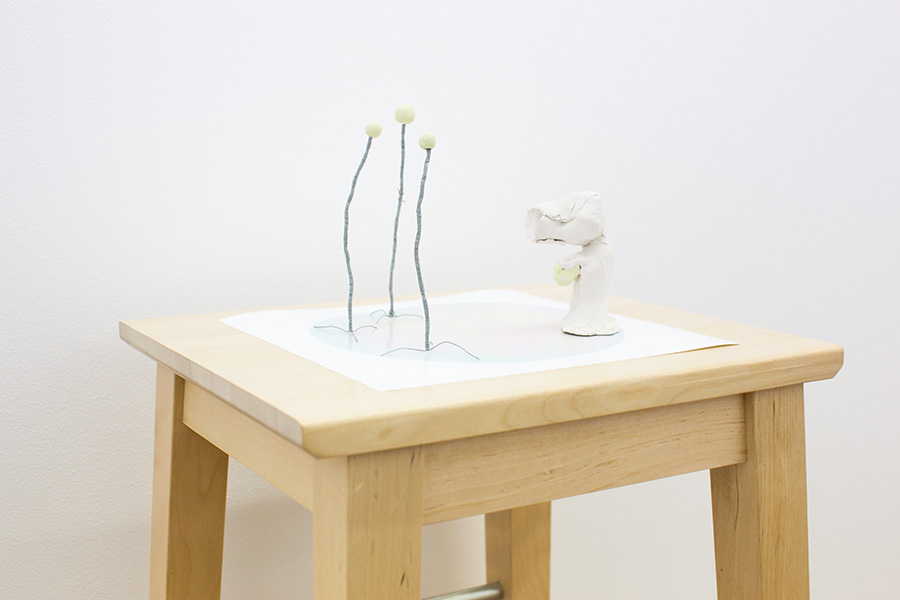
Sculpture/Collage: Sandra Selig
Paintings: Vernon Ah Kee

Sandra Selig’s works look like interstellar origami - where planets, nature and fractals envelope each other.

The images are from outdated science textbooks. They have the quality of images in old atlases. Their treatment captures the 20th century. I mean the aesthetic has the colours and character of film photography particular to the 20th century.

“[I] find a lot of the images very moving,” says Sandra.

“I like that the text does not reflect that, so it leaves room for me to re-interpret.

“With the folded works, I like the unexpected pairings of images when you fold over a page that has an image on both sides.

“It has multi-dimensional play.”

The works seem like they’re still evolving. While delicately and purposefully arranged, they appear to be in a state of growth. I suppose much like the nature of the universe or our environment.

“I think it's interesting if the work doesn't completely know itself but is partially in a state of trying to do so. It's a puzzling soul, more like a garden.

“Changing in time, reaching for the sun, but also staying in the earth it was planted in.”

The NSW-born artist completed a Masters in Visual Arts at QUT in 1999. Sandra has exhibited internationally, notably in Britain and Japan. Her interests also extend to music as an active member of the underground Brisbane music landscape. Previously Sandra played in The Deadnotes and now she’s half of the lo-fi electronic band Primitive Motion. She’s combined the two mediums.

Sandra partnered with her bandmate Leighton Craig “on Visual Art/music hybrid projects”.

In March the duo will release their second LP to which the artwork will be integral and complementary. In the same month Sandra will exhibit two major installations - one at Sydney’s MCA and the other at the NGV in Melbourne.

Until then, take a look at Sandra’s latest works. They’re kind of calming, natural and nostalgic. 


Also at Milani Gallery but with a very different quality - Vernon Ah Kee’s paintings.


Above: Sculpture/Collage works by Sandra Selig


Above: Paintings by Vernon Ah Kee


21 September 2014

Being Female at The Hold


Images: Jonathan Rae
Words: Saskia Edwards
Artwork: Heidi Stevens and Carolyn McKenzie-Craig

What is it to be female?

In the 21st century it goes beyond the basic physiological elements that make up the gender - hips, breasts, the womb. To be a modern female, women have to fulfill a myriad of expectations.

Women are expected to work, to be ambitious, to be independent, while still being caring, and maternal and beautiful and feminine and basically encapsulate everything Beyonce has set unreasonably high standards for. 

Heidi Stevens’ soft pastel sculpture captures the 21st century female experience.

“Contemporary feminism has come so far as far as women can have jobs and get an education and birth control - all of the larger things that we all know about.

“But on the flip side I feel like not only are we able to, we’re expected to, but we’re also expected to retain our female role as caregiver, not just to children, but to the community and elderly parents.

“And we’re meant to earn as much as our male partners, but also be the caregiver and take on all these extra roles as well as domestic duties and all of that.

“So I feel like there’s a dualism there; we’ve got a lot more options, but we’re still grounded in the expectation of our biology and our history.”

Heidi’s sculptures were created in a matter of minutes and as Heidi is a new mother they are aptly titled While the Baby Sleeps. The works, perhaps as a result of the timeframe they were created in, seem to peel back experiences to their rawest form. The colours and shapes are at the essence of an emotion or experience - the vagina, birth, love, fighting, motherhood. 

There is also a series of Heidi’s photographs at The Hold. Heidi comes from a photographic background and has used the medium throughout her practice. 

“I’m quite fascinated with the language of commercial photography - high end fashion images and how they’re selling a particular lifestyle or branding.

“So I kind of highjack that, lighting and the way I print my work and present it, so that I can attract a viewer that maybe wouldn’t look at my work if they just knew the raw content about it being dissatisfaction with the contemporary world as a female.”


Heidi ultimately makes a comment on what it is to be a woman in all its banal shared experiences engrained through centuries of stereotypes. Being a woman in the 21st century is a contradiction: soft yet hard, beautiful yet tough, a nurturer and a leader.


20 August 2014

Anthony Lister on toilet democracy, living hard and what's new?


Words: Saskia Edwards
Images: Jonathan Rae

I've done hundreds of interviews in my life, but none as strange as with Anthony Lister. He's somewhat of a deity in the street art realm. He's achieved international success and has, arguably, helped redefine the concept of low-fi art. I spoke to Lister, on loudspeaker, while he was driving, and navigating through traffic. I couldn't hear him very well, or sometimes make out what he was talking about. So here's how it went:

SE: What have you been up to recently?

AL: I've been traveling to New York and Paris. Now I'm back in Australia.

SE: I know you do travel around a lot. Do you feel like the different places you go to perhaps influence your practice?

AL: I guess everywhere influences my practice.

SE: I noticed recently you were talking about cleaning up graffiti. You might know in Queensland here we've got the 'Tag Them Back' campaign and I spoke the guys from Jugglers and stuff about it a while ago. And I was just wondering what your thoughts were on this kind of campaign against street art?

AL: I don't know what that campaign is about.... I don't know anything about that campaign. You want to talk to me about it? Are you an advocate for that shit?

SE: Basically it's about, they've got all these signs everywhere on the trains and everything and it's basically saying, 'if you see someone doing any kind of graffiti, you should report them'. And it's kind of got all these stereotypical portrayals of people vandalising things. And when I spoke to the guys from Jugglers they were pretty upset about it because they felt like it was perpetuating a pretty bad stereotype.

AL: Yeah exactly. Look Brisbane's just been all about stereotypes from the get go. 

SE: Is there anything you're working on at the moment in particular?

AL: What am I working on? I'm working on a bunch of paintings for a show in London...

SE: What's the themes throughout the paintings, if there is one?

AL: The themes there always about famous quotes from history - Martin Luther King, guided message, misguided men.... Even Chopper Read. There famous quotes that all make all this work out of it. I don't know, what am I interested in? I'm interested in freedom of visual speech, I think it's quite ironic and very contradictory of any governments to get rid of graffiti when the very act of them advertising it is graffiti. The sort of contradictory propaganda that goes on about creativity. I can't see anything more sickening than someone stealing someone else's fun from them. 

SE: Is there anything in this particular series that you're trying to get across or that you're focusing on?

AL: Well, yeah. Women in roller skates, shadow, reflection in mirrors. I'm interested in black rooms as much as Matisse was interested in red rooms... It's just a conversation about the history of our species. As far as the freedom of visual speech goes. It's part of the public intervention this visual public intervention. It's only been illegal for 30 years you know, our species has been alive on this earth for eight thousand years. So I don't know what we're talking about.

SE: Now this is something my photographer was really interested in, he wanted me to ask you about the kind of distinctive style that you use. And he particularly interested in the faces that you paint and he kind of wanted to know what was behind the face, and what led you to depict people in that way.

AL: I don't know. You should just put this online as a recording. Honestly, I don't know if you've looked at my work or anything. I don't know, have you read any interviews and shit that I've done before? Because I've kind of said a lot of this stuff before. I'll tell you what's behind the face, it's just more paint, it's just other faces. The faces change, you know. I don't make work that's pretty, I'm not interested in making things pretty, it's just about process you know. Things grow on you.

SE: What do you want to to talk about then?

AL: I'll talk to you about anything. I'll talk to you about new things. Let's talk about new things.

SE: Well what's new in your life, what are you interested in outside of your art?

AL: It's not about my life. Let's talk about the people... What's new in the world? Let's talk about legislation changes, let's talk about activating change. I'm very interested in activating change. Not that I have any power to do it. We're powerless people. You know what I do when I go to a public toilet? I write 'vote here' above the toilet roll. I mean, it's one devil or the other... It's got to start in education. We spend so much time at school. I just knew what needed to happen... Too many people are just living soft and partying hard. 

SE: So what do you want to see happen, what legislation are you interested in? What do you think needs to happen?

AL: I'm interested in land rights and culture. I'm not interested in sport... It's only interesting if you're interested, I guess. I'm not really even concerning myself with these things. It's just too sad, there's too many tragedies in the world. You know something's gone terribly wrong when a disaster is dressed as entertainment... You know something's gone terribly wrong when public art is dressed... when terror is dressed as public art. There's a car here in Sydney that's been crushed with a rock, and it's public art. Apparently, in a private public space. I don't know how that exists. This rock, and calling it art. In a lot third world countries right now they're war torn and children are dying at the hands of these pigs with weapons. They dress up a car here in Sydney and call it art. I mean Sydney's great... but it's got a leniency towards acts of public intervention, creatively. To put all that art and take some kid to court of give them jail for popping a tag on it, it's ridiculous.

SE: Is there anything else you want to add, is there anything you want to talk about, is there anything you want to get out there?

AL: No, not that I haven't said before. I didn't need to do this shit, but I said yes because I thought there'd be a new question. But it's alright... I'm not really sure what the world's going to get out of me being set up with reading about myself.

SE: Well I think a lot of people look up to you. Particularly in Queensland here. Come on, what have we got around? There's not many people saying they don't like sport, so you've certainly broken that mould.

AL: Awesome, I like it.

SE: Well you're legacy will be the only Queenslander who didn't like sport. Trust me, you're already my idol.

AL: Yeah baby. Have you seen my new book? I've got a new book out.

SE: Oh yeah? What's it all about?

AL: It's called 'Adventure Painter'. So I don't know if it's in book shops yet, but you can order it online. And it's a big hard cover book.

SE: Well good luck, thanks for chatting with me. And I'm sorry if I bored you with my questions.

AL: No no no, you didn't you didn't you didn't. You're great.


9 August 2014

Welcome to Trashtopia: Maison Briz Vegas on nostalgia


Words: Saskia Edwards
Images: Jonathan Rae

It was 1964 and I was walking down Main Beach, down near the abandoned ship. There’s this kid eating a Cornetto. He tried to eat the bottom first now he’s got ice cream all over him. His mum – a creased woman in a neon pink one-piece – tells him to go swimming to wash it off. She watches him – with a kind of angry maternalism. The congealed sugar has his fingers all stuck together. There’s a couple – she’s Japanese and wears her hair in a knot – while the guy doesn’t have sunblock on just tribal streaks of zinc. Then there’s a woman walking her dog. The retriever is all covered in brine while she is in a daze, just following it kind of hypnotically. Really, they all look the same – squinting, lazy and melting into the orange haze. That’s how I remember 1964.

With Maison Briz Vegas you feel all nostalgic.  It makes you see Jean Shrimpton in her white shift, Robert Menzies’ eyebrows and faded pink Queenslanders.

But it’s also about Paris. The label was born from discarded t-shirts at Parisian flea markets.

But the label goes beyond just repurposing t-shirts. The design duo Carla van Lunn and Carla Binotto use bespoke techniques to transform the tops.

“We wash the textiles, we dye them, we print them by hand, normally block printing or stenciling or screen-printing and then we create new garments,” says van Lunn.

“We unpick and re-sow them and we use a lot more couture and craft technique than what you normally find in t-shirts – a lot of hand sowing and embellishments even with rubbish materials.

“For example buttons are often created from jar lids.”

Maison Briz Vegas began during the thick of the Global Financial Crisis when established labels were going bust.

“And I wanted to design a collection that kind of responded to that sense of precariousness in fashion and also I am interested in the environmental impact of the fashion industry,” says van Lunn.

Maison Briz Vegas’ latest opus Trashtopia looks like a 1960s tropical paradise. But in fact the sand is littered with rubbish and the Hawaiian prints are laced with more forbidding themes.

“For example, you see there’s a dress in the exhibition, which has tortoises on it, but if you look closely, it’s turtles with plastic milk bottle rings and some of the turtles actually have been trapped inside the milk bottle links,” says van Lunn.

The collection references modern society’s insatiable consumerism, mirroring the growth in affluence and cheap manufactured products in the post-war era. Similarly, we live in a prosperous world that is riddled with environmental degradation and overconsumption.

“We’re looking at that from a post-industrial in an era where climate change is a pressing issue,” says van Lunn.

“We looked at how plastics and consumer products are really now destroying our planet and so we tried to take that dark message, with the pollution of the ocean, and weave it back into the story of this utopian, sunny, cheerful 1950s-1960s vibe”


The collection is currently exhibited at Artisan.


3 August 2014

Sustainable decoration: Artisan’s Greensmith exhibition


Words: Saskia Edwards
Images: Jonathan Rae

Marshall Mcluhan famously coined the phrase, “the medium is the message”. Meaning, that in fact the medium to communicate a message can be more impactful than the content of a message itself.

Artisan’s Greensmith exhibition is a collaboration between Queensland and Californian jewellers. The pieces all have the underlying unifying themes of sustainability, environmental consciousness and preservation.

Of course, the medium to express those concepts is through jewellery – from intricate silver adornments to large plastic sculptural neckpieces.

And in this case it seems that the medium is as important as the message. As if this didacticism needs to be seen in this form – that the destructive practices of humanity can be better understood through something beautiful and yet sustainable.

Kathleen Hunt’s serpentine neckpiece is featured in the exhibition. It effortlessly drapes across the mannequin but also sits with rigid structure.

For Kathleen, the jewellery itself is crucial in expressing an idea.

“Now we tend to virtually adorn ourselves with trophies – essentially, don’t we?

“‘Look what I’ve got, and my watch, and my gorgeous earrings and my this and my that.’ So I’m actually turning that around and rather than saying, ‘this is a trophy’, saying, ‘now well this is what we’ve done and we have to wear the consequences of it’.”

The sculptural piece is created primarily through deconstructed coat hangers.

“My sister works in retail and she kept bringing home these beautiful Birchwood coat hangers.

“And the thing about these hangers is because they had a name on them, they didn’t even hit the racks in the shops, they were just used for transportation and then they were discarded.”

In fact, each year around eight billion coat hangers are produced – enough to fill the Empire State Building more than four times. Kathleen’s practice draws attention to this gross waste and overproduction. Yet her piece is beautiful, which is somewhat contradictory as the iridescent gleam of the hangers is a result of the heavy metal used to create them – chrome. It’s as if artificial beauty is inherently noxious.

Kathleen is intent on keeping her materials as raw as possible. In fact, the naturalness of the manufactured products is enhanced by the Fibonacci pattern seen throughout nature, which is used in her neckpiece.

“I won’t force the material to do anything that isn’t in its nature and I think if we look throughout our landscape and took the same approach, things would be different.

“If we stopped forcing our environment to be something that it’s not.”

Kathleen’s sculpture, along with all the other artists at Greensmith highlights the environmental degradation caused by humanity’s insatiable consumption. And the message is in the medium – the works prove that not only can jewellery be sustainable, but it proves the ugliness of mass consumption.


As Kathleen says: “I think that’s the job of the artist – to notice change and to bring it to attention.”


26 March 2014

Danie Mellor’s Exotic Lies and Sacred Ties exhibition at UQ Gallery


Words: Saskia Edwards
Images: Jonathan Rae

Within 20 years of white settlement in the Atherton Tablelands, the indigenous population was reduced to 20 per cent of their pre-contact numbers. European diseases like measles and influenza took many victims. But it was the wholesale murder by settlers that was the main contributor to the almost complete obliteration of Dyirbal speakers.

This is Aboriginal and Torres Strait Islander Art Award winner Danie Mellor’s mother’s country. The compilation of his works over the last 11 years at the UQ Gallery presents a history of the Atherton Tablelands and the rainforest people.

Danie’s pieces offer binary views from colonial and indigenous perspectives. It creates a kind of synergy to highlight how the cultures are vastly different, but share commonalities.

The themes explored across the exhibition include ritual and safekeeping, memento mori, culture warriors, silent witness and arcadia.

Curator at UQ Art Museum Samantha Littley says she and the head curator Maudie Palmer used these motifs to fully explore the concepts in Danie’s art.

“So for example with the ritual and safekeeping theme there was this idea that ritual knowledge and the handing on of sacred knowledge is something that common to many societies.

“There’s all sorts of ritual knowledge that’s passed on through visual and oral histories [in the indigenous community].

“And then kind of counterpointed against that is the masonic rituals that are perhaps more closely associated with European culture and what he’s saying in fact is that there are similarities, but there’s differences between those two things.”

Many of Danie’s mixed-medium pieces are reminiscent of blue-and-white Spode China. But instead of whimsical oriental pictures, the paintings depict native Australian peoples, flora and fauna or macabre and disjointed scenes of colonialism. Spode China represents the Chinoiserie popular at the time of white settlement in Australia. In Danie’s works it seems to symbolise the forced invasion of western culture on the tranquil, but confused native population.

Samantha says the ornate frames and shimmering materials in Danie’s works attract the viewers’ gaze. At first, it seems quite beautiful. But then more poignant messages arise.

“So what he does is he draws you into that picture,” she says.

“And initially he does that with things like the gold and the glitter, which are obviously very visually appealing and attractive in a way.

“But then once you’ve entered into that looking with him, he shows you other things that are perhaps a little bit more complex and possible more difficult to consider, but he does it in a very gentle way and there’s no course to blame.”

It’s a pivotal moment in Danie’s already illustrious career. He was recently included in the inaugural international survey of Indigenous art in Canada and will be shown this year at Art Basel Hong Kong.


The 50 artworks on loan from galleries including the Australia Museum, the National Gallery of Australia and the Queensland Art Gallery are on exhibit until April 27th.