Showing posts with label femininity. Show all posts

27 June 2015

Quaternary exhibition at QUT Art Museum


Words: Saskia Edwards
Images: Jonathan Rae
Artworks: Bianca Beetson, Chantal Fraser, Rachael Haynes, Natalya Hughes, Alice Lang, Gemma Smith, and Jemima Wyman

Bianca Beetson says “we were all born pink, even when a dark baby is born, it’s still pink at first”.

And it’s that colour, which is so deeply imbued with meaning, that underpins Bianca’s work.

“I was a bit of a tomboy growing up and my mother, I remember her, as a last ditch attempt putting me in this pink bedroom,” says Bianca.

“It had pink clouds on the wallpaper and on the bedspread. And I really don’t like the colour pink.

“I ended up reclaiming pink in many ways and my hatred for pink became about anger and how pink’s not necessarily this insipid colour that’s associated with girls it can actually be quite powerful.”

Bianca’s self portraits at QUT’s Quaternary exhibition are bathed in fuchsia, blush and coral. Her costume changes from soldier, to barbarian to bohemian. It’s kind of this strange journey of mercurial magenta identity. And Bianca’s wrestle with identity is inexplicably linked to her aboriginality that of course is steeped in complex history and politics. 

“I always struggled with this thing of, who am I? and being pigeon-holed and people expecting you to act and behave in a certain way.

“And I think back to my uni days and I’d turned up nearly every day dressed as a completely different person because just when someone had thought that they had got me figured out... where to put me, I would shift.”

The pink in Bianca’s practice extends beyond femininity and self-perception. It looks at the “artificiality” of Australian history and “the way that pink sort of signifies this candy-coating”.

“I talk about sugar-coating poo and you can even sugar-coat poo that much and make it palatable.

“And at the end of the day it’s still poo.

“‘Let’s cover it up, let’s sweeten it’, but the problem doesn’t go away.”

Bianca has looked even further into that richly emblematic colour and found the concept of assimilation. Bianca’s grandmother was a domestic in Cherbourg where she “was taught to be a good woman, a good cleaner, a good cook, to stitch and sow and do all of those domestic things”. For Bianca, this represents the assimilation of her culture, heritage in family.

In the end, history, gender, identity: they're not white washed, they're pink washed.


21 September 2014

Being Female at The Hold


Images: Jonathan Rae
Words: Saskia Edwards
Artwork: Heidi Stevens and Carolyn McKenzie-Craig

What is it to be female?

In the 21st century it goes beyond the basic physiological elements that make up the gender - hips, breasts, the womb. To be a modern female, women have to fulfill a myriad of expectations.

Women are expected to work, to be ambitious, to be independent, while still being caring, and maternal and beautiful and feminine and basically encapsulate everything Beyonce has set unreasonably high standards for. 

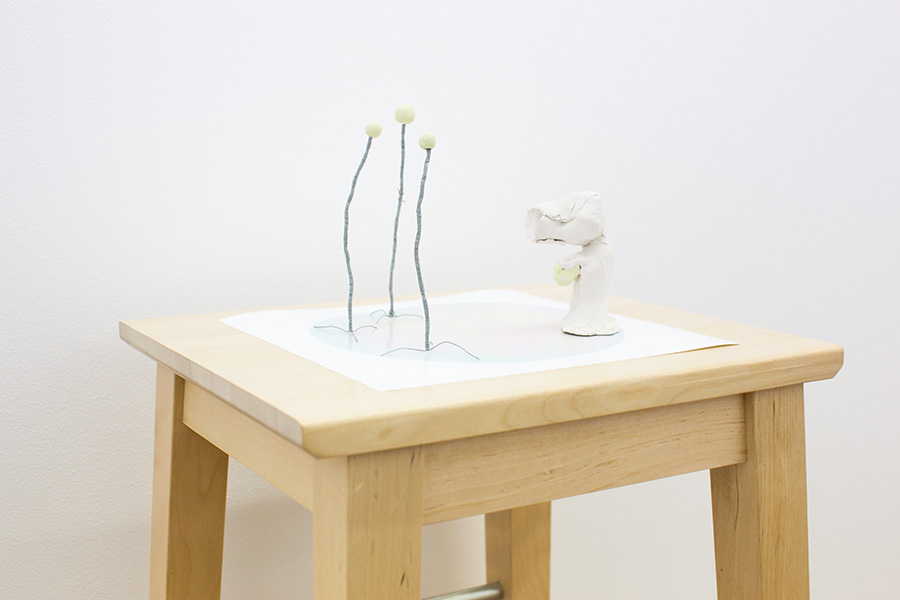
Heidi Stevens’ soft pastel sculpture captures the 21st century female experience.

“Contemporary feminism has come so far as far as women can have jobs and get an education and birth control - all of the larger things that we all know about.

“But on the flip side I feel like not only are we able to, we’re expected to, but we’re also expected to retain our female role as caregiver, not just to children, but to the community and elderly parents.

“And we’re meant to earn as much as our male partners, but also be the caregiver and take on all these extra roles as well as domestic duties and all of that.

“So I feel like there’s a dualism there; we’ve got a lot more options, but we’re still grounded in the expectation of our biology and our history.”

Heidi’s sculptures were created in a matter of minutes and as Heidi is a new mother they are aptly titled While the Baby Sleeps. The works, perhaps as a result of the timeframe they were created in, seem to peel back experiences to their rawest form. The colours and shapes are at the essence of an emotion or experience - the vagina, birth, love, fighting, motherhood. 

There is also a series of Heidi’s photographs at The Hold. Heidi comes from a photographic background and has used the medium throughout her practice. 

“I’m quite fascinated with the language of commercial photography - high end fashion images and how they’re selling a particular lifestyle or branding.

“So I kind of highjack that, lighting and the way I print my work and present it, so that I can attract a viewer that maybe wouldn’t look at my work if they just knew the raw content about it being dissatisfaction with the contemporary world as a female.”


Heidi ultimately makes a comment on what it is to be a woman in all its banal shared experiences engrained through centuries of stereotypes. Being a woman in the 21st century is a contradiction: soft yet hard, beautiful yet tough, a nurturer and a leader.