Showing posts with label Australia Contemporary Artists. Show all posts

24 April 2016

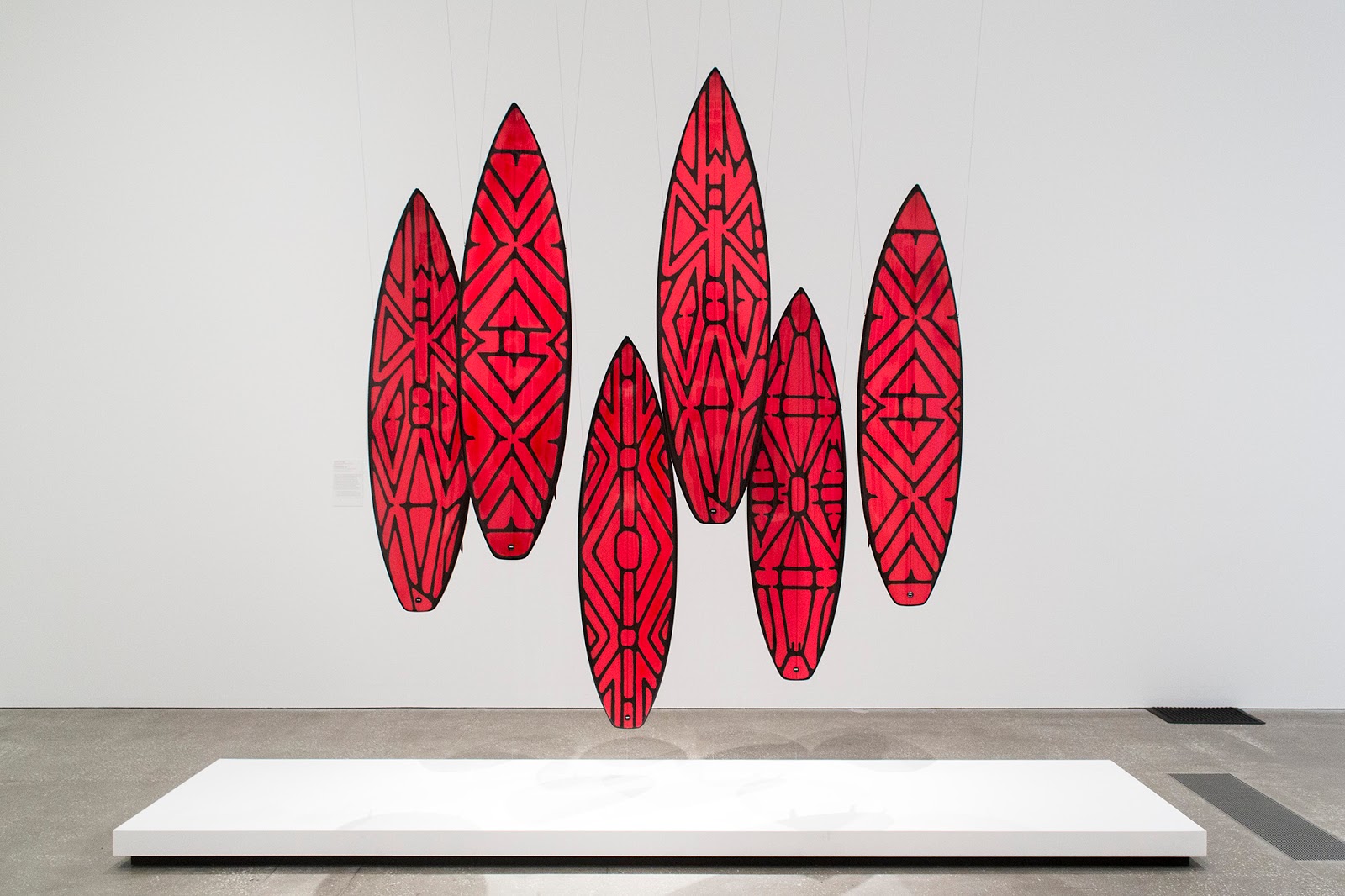
20th Biennale of Sydney 'The Future Is Already Here - It's Just Not Evenly Distributed'


Words: Jonathan Rae
Images: Jonathan Rae

It's the 20th time the internationally acclaimed Biennale of Sydney has run.

The show is curated by Stephanie Rosenthal and presented at a bunch of places around central Sydney known as 'embassies'.

The works on show encompass everything from found objects, video installations, kinetic sculpture, performance 'art' to more traditional mediums such as painting.

Rosenthal's concept for the curation of exhibition was to assign each embassy an idea of thought. For example, the Cockatoo Island venue was assigned 'Embassy of the Real' and the Carriageworks venue 'Embassy of Disappearance'.

This Biennale may be big on thought, but the ideas translate poorly in the work on show. Although each location is assigned an idea or concept, there appears to be no cohesive message or aesthetic at each location besides what we are told we are supposed to feel through vague didactics.

There are a lot of Instagram-bait works that rely on scale - like that of Lee Bul's installation that can only be described as a deflated looking circus tent mixed in with some hot air balloons and fairy lights (a far cry from her previous intricate and complex works) or William Forsythe's pendulum room. Otherwise, a lot of the work fails to stand out.

The banality of the curation is even more amplified on Cockatoo Island and at Carriageworks where the gallery space and architecture is often more interesting than the work on offer. The pieces on show often rely too heavily on buzzword loaded didactic panels and fail to convey the ideas the curator had hoped to express. It falls into something akin to university student work, loaded with supposed concepts, unloaded with presentation and execution.

Basically, the banality of the works and ideas leave the viewer with a rather flat feeling at the 20th Biennale of Sydney. If this is what the idea of the future feels like, I want off this ride.


19 December 2015

Julian Meagher 'Alone in the Sun' at Edwina Corlette Gallery


Words: Saskia Edwards
Images: Jonathan Rae

I think everyone has had a moment where they become conscious, and feel very acutely, that they are a product of their parents. Maybe it’s your same fear of cats as your mother, or that you like your toast slightly burnt like your father, or that you’ll always vote Labor because they told you that’s what’s right. 

But more than these obvious, more tangible things, your parents can deeply and permanently instil in you your values, opinions and beliefs. And it’s only when you're spraying your neighbour’s Tabby with your garden hose do you realise it.

But what about their parents? And your parents’ parents’ parents? How has that influenced you?

Well, that’s what painter Julian Meagher is looking at. 

“I think we can all see traits of ourselves in our mum and dad and, then I’m looking at further, well they’ve obviously got their parents in them as well,” he told me.

“We all must inherit something and as a nation, we have these shared traits as well - our love of drinking, our love of the beach, our identity, what makes us who we are?

“And I think as you get older, you start to look back and ask, ‘Why am I, who I am? Why do I have these values? And why do I react in these ways?’”

The hero piece of this series, ‘Alone In The Sun’, is a shadowy image of a group of turn-of-the-century women. They pose for a photo in an austere style with seemingly transparent faces. It has the same feeling as Jane Campion’s ‘The Piano’. It’s eerie and also distant. These women are Julian’s ancestors. 

“I was at christmas dinner and I looked at the wall and there was the really powerful ghost-like image of these women from the early 1900s and I said, ‘who’s this?’, and she [Julian’s mother] said, ‘It’s your great-great grandma who lived out in the bush’.

“I’d never seen this image and they were so ghostly, it was such a powerful image.”

Julian also looks specifically at the relationship between drinking in Australia and our ancestry. 

“I started looking at broader things around masculinity and Australian identity years ago with drinking culture and things because I like painting bottles.”

In this series there are paintings of bottles, some fallen, others acting as vases for native Australian flowers. They are symbols for our uniquely Australian relationship with alcohol.

“In other countries, for example in Italy, if you get too drunk, you dishonour the family, in Australia the more drunk you get, the more honour you bring.

“Our Prime Minister holds the record for sculling a beer, our famous cricketer David Boon holds the record for drinking 52 tinnies on a flight to London. They’re our heroes.

“It’s very engrained in our culture because Australia’s very isolated, it’s all about how tough you are, how stoic you are.”

It’s worth noting here, that Julian hasn’t always been an artist. In fact, he’s still a registered doctor. 

“The switch is easy, having a career as an artist is the hard part.

“I think it’s way harder to be an artist than to be a doctor to be honest.

“To keep creating the works, it’s such an unstable career. Art is very difficult financially, particularly in early years and it’s a very, very tough road and it’s quite a solitary thing.”

His works are influenced by his medical career. His painting is very clinical. He’s “no wild, crazy artist”. And it is evident in his clean, precise works, that really do examine history, drinking and identity.

So, are we ‘Alone in the Sun’? Really, we’re not alone. We’re the combination of thousands of ancestors, people we’ll never know, but who have shaped us.


23 August 2015

Contemporary Queensland Artists at GOMA Q: Spotlight on Sam Cranstoun


Words: Saskia Edwards
Images: Jonathan Rae

Lord Louis Mountbatten - the cousin of the Queen - was responsible for funding an affordable braille typewriter, developing a particular shade of pink and was a supporter of a military ship made from ice and wood pulp. 

Then, in 1979, he was assassinated by the IRA. They blew up a fishing boat he and was aboard off the coast of the Irish town Mullaghmore.

Sam Cranstoun remembers this quizzical and benevolent royal in his works at GOMA Q. 

“I came across this figure Mountbatten who was connected to the British royal family, but also connected to the Russian royal family.

“All of these little stories kept presenting themselves and they were just increasingly fascinating.

Perhaps Mountbatten was also motivated to think up these schemes by a desire to prove his relevance as a royal. It was an era where the divine rights of the monarchy were being questioned. Hence it’s possible that Mountbatten was attempting to justify his position through, somewhat misguided, ingenuity.

“He really was clearly striving to do good things. They were incredibly earnest.

“A lot of them were quite ridiculous and outlandish, but they were all really based in fascination with innovation, but also by having a military edge.”

Sam’s exploration of the Mountbatten narrative manifested itself in three ways. Firstly, a flag dipped in Mountbatten pink - a mauve hue he thought would be an effective camouflaging colour for the military (but was probably a bit too fabulous). Secondly, a canvas punched with braille. It reads “remember in spite of everything he was a great man”.

“There was a biographer that was writing the official Mountbatten biography and he did exhaustive research through his archives and work with him directly.

“And apparently Mount Batten had quite a flair for exaggerating his role in history.

“This biographer, his whole life was made exceedingly difficult by the fact that we would hear the story and find out the story from Mountbatten and then would have to perform more research to actually determine if that was actually true or not that was an incredibly frustrating for him.

“To the point where he actually made a plaque that was his own personal mantra that said, ‘remember in spite of everything he was a great man’.”

And finally, a film. Sam travelled to Mullaghmore, the site of Mountbatten’s murder, to trace his final days and examine the scar the event left on the town.

“It’s fair enough and it’s justifiable and understandable that they [the IRA] wanted their own country and that they wanted to take it back for themselves.

“But then the way they went about doing it was so morally bankrupt it was so wrong, the way that they would kill innocent people just to bring attention to their cause.”

“I was interested in how my relationship with the story would actually change by visiting Mullahgmore.

“One of the things that I thought would be an interesting activity while I was there was to actually go out in a boat and see the waters that he would have seen everyday and seen while he was killed.”

The video is quite soft and placid - it follows the rolling landscape of Mullaghmore - that is often interrupted by the monolithic Classiebawn Castle. And there always seems to be a faint serene wind. But it’s like the town has a thin film of serenity enveloping a much greater turmoil.

Sam contacted a charter boat company about taking a trip around the idyllic peninsula. They couldn’t take him, but the operator actually knew Mountbatten. In fact, she maintained his boat for a decade and was familiar with him. Sam spoke to her over two days about the assassination, Mountbatten and how the event has shaped the town. It was, quite obviously, an emotionally charged issue for her - with her regularly breaking down during the interview.

“I was very aware that clearly this isn’t something that has just disappeared and it wasn’t just going to disappear – it was a story that was forever linked to the town.

“I knew it was something that preoccupied her quite a lot, but I didn’t expect her to be quite as emotional as she was.”

Sam’s series was quite sombre. But simultaneously quite meditative. It shows, through a very specific window, how one person can become the epicentre of so many peripheral issues (modern royalty, the War of Independence, the military). And it shows how the waves of one person’s life have carved permanent grooves in many people’s minds. 

Here's some of the other works by contemporary Queensland artists on show at GOMA Q.


27 June 2015

Quaternary exhibition at QUT Art Museum


Words: Saskia Edwards
Images: Jonathan Rae
Artworks: Bianca Beetson, Chantal Fraser, Rachael Haynes, Natalya Hughes, Alice Lang, Gemma Smith, and Jemima Wyman

Bianca Beetson says “we were all born pink, even when a dark baby is born, it’s still pink at first”.

And it’s that colour, which is so deeply imbued with meaning, that underpins Bianca’s work.

“I was a bit of a tomboy growing up and my mother, I remember her, as a last ditch attempt putting me in this pink bedroom,” says Bianca.

“It had pink clouds on the wallpaper and on the bedspread. And I really don’t like the colour pink.

“I ended up reclaiming pink in many ways and my hatred for pink became about anger and how pink’s not necessarily this insipid colour that’s associated with girls it can actually be quite powerful.”

Bianca’s self portraits at QUT’s Quaternary exhibition are bathed in fuchsia, blush and coral. Her costume changes from soldier, to barbarian to bohemian. It’s kind of this strange journey of mercurial magenta identity. And Bianca’s wrestle with identity is inexplicably linked to her aboriginality that of course is steeped in complex history and politics. 

“I always struggled with this thing of, who am I? and being pigeon-holed and people expecting you to act and behave in a certain way.

“And I think back to my uni days and I’d turned up nearly every day dressed as a completely different person because just when someone had thought that they had got me figured out... where to put me, I would shift.”

The pink in Bianca’s practice extends beyond femininity and self-perception. It looks at the “artificiality” of Australian history and “the way that pink sort of signifies this candy-coating”.

“I talk about sugar-coating poo and you can even sugar-coat poo that much and make it palatable.

“And at the end of the day it’s still poo.

“‘Let’s cover it up, let’s sweeten it’, but the problem doesn’t go away.”

Bianca has looked even further into that richly emblematic colour and found the concept of assimilation. Bianca’s grandmother was a domestic in Cherbourg where she “was taught to be a good woman, a good cleaner, a good cook, to stitch and sow and do all of those domestic things”. For Bianca, this represents the assimilation of her culture, heritage in family.

In the end, history, gender, identity: they're not white washed, they're pink washed.


7 June 2015

Amber Wallis and Ari Athans at Edwina Corlette Gallery

 
Words: Saskia Edwards
Images: Jonathan Rae

The uncanny was a concept first characterised by Sigmund Freud in his essay Das Unheimliche. It’s that feeling when something looks simultaneously distinctly familiar and distinctly unfamiliar. It’s probably how you felt when you watched The Polar Express or saw a RealDoll or maybe that time you went to Madame Tussauds.

Within Amber Wallis’ work the uncanny takes on a different shape. In her paintings you catch glimpses of recognisable forms - a cactus, palm trees, clouds. But at the same time they look totally alien; like the landscapes have been melted, contorted and warped.

“A lot of people can read what they want into it and they might see objects or land or sex or what have you,” says Amber.

“And I think that’s an interesting place because it’s kind of neither here nor there. So then it’s not super obvious.

“I find straight portraiture or straight landscape, I just get a bit bored of it. If I’m painting myself, it’s something that gets a bit stuck for me.

“So I do like that space where things are a little bit confusing.”

Amber’s works tread the precarious line of representation and abstraction. Forms often fall off the precipice of reality into a more visceral interpretation of the objects or landscapes. It’s also a method of Australian artist Ken Whisson.

“I just love the way he composes his imagery and especially his earlier works.

“There’s just something, that line between abstraction and representation, and once you’re going down that path it does become about the painting and the formal qualities of it and I just think he nailed it, I just think he’s an amazing painter.”

Inherent in Amber’s works is her emotional state. Her mother died a few years ago and that grief has been laced through her process.

“Well you go through big heavy grief stuff you get very aware of the preciousness of life, the fragility of it.

“I think thematically, I was thinking of my mum and a lot of the objects she used to have around the house.

“She used to be a ceramics artist and in the back of my mind, I was sort of thinking of that stuff.

“I don’t think it shows in the work that much, but I know that it’s been created in that space.”

In validation of her talent, Amber was awarded the Brett Whiteley Travelling Art Scholarship.

“It meant that I have continued to have an art career one way or another.

“It really changed my life, enabled me to travel and be funded while I travel and make art for the first time in a full-time capacity for a certain amount of time.”


Now Amber is preparing for the Sydney Contemporary in September. But for now you can see her exhibition at Edwina Corlette Gallery. And really, you can see whatever you want in the uncanny. 


22 February 2015

Michael Zavros: unaffected opulence


Words: Saskia Edwards 
Images: Jonathan Rae
Original artwork: Michael Zavros

The grey veins of the marble pulsate.
Like muscular nacre - blemished with blue.
Perpetual beauty.
The perfect form.

Michael Zavros’ affinity with horses is obvious. So often has his work captured the spectacular physicality of the creatures.

But that equestrian pomp is also filled with a kind of shy mystery unique to horses. It’s bravado that’s matched with a timidity. Like they never lose their wildness.

While horses are often sociable - it’s married with a reclusiveness. In fact, there seems to only be tenuous collective nouns for the species.

And in some ways I see a parallel with Michael Zavros and the animal that’s been at the centre of so many of his pieces. 

With many works saturated in luxury and pageantry, it’s hard to imagine Zavros as the humble, unaffected man that he is - even wearing the same beat-up pair of Crocs that I’ve seen and read about in so many spreads.

But in many ways he’s a calm, in fact introverted, person. Despite travelling to exotic and glamorous destinations, Zavros is content in his Chandler hermitage (for now).

“I’m not a very extroverted person in public that can seem quite the opposite to what you just suggested.

“I can seem very aloof or arrogant.

“It’s often said to me when people are interviewing me or I meet someone that I’m much nicer than they expected. So I’m kind of aware of the different ways you can be perceived.”

Zavros’ working space - a detached white warehouse saturated in natural light, with exposed blonde wood, and a view of the chickens - is a sanctum.

“I live very deliberately in a vacuum here in Brisbane and we have a bit of an island.

“I don’t get out much and... now that I’m home I realise that I don’t speak to people during the week - I’m just doing my own thing.

“And that can be very grounding - I very deliberately sit outside of the art world. I think my work can be a part of the art world, I don’t really have to.”

The walls and tables are lined with taxidermy, skulls and books - cheetahs and peacocks’ glass eyeballs follow you. It’s somewhere between Georgia O’Keeffe and Rembrandt’s studios while taking a stroll through Versailles. And, of course, you have the choice to recline on a Chesterfield sofa or Corbusier chaise lounge.

It’s like stepping back into Zavros’ curated exhibition for the Queensland Art Gallery.

“Instead of curating a show I sort of curated a character or a persona,” he says.

“It was very autobiographical - it shouldn’t be a surprise that you would feel like you’re in the same space.”

There’s a few differences: a sewing machine and patterns (evidence of his daughter’s foray into fashion design) and a kite, which belongs to his son Leo. Apparently they’re unfazed by their father’s success.

“That is just their everyday existence, this is how everyone lives, everyone’s dad is at home doing these things,” says Zavros.

“And every now and then they’ll observe that we do live differently to some of our friends or have a different take on life or they’re exposed to different things.”

Unlike most dads, Zavros was commissioned to paint Victoria Cross recipient Corporal Ben Roberts-Smith for the Australian War Memorial. It’s quite a departure from his paintings of Prada shoes, Rolls-Royces and floral arrangements. But it still retains Zavros’ aesthetic - laced with classicism and modernity.

“That’s one of those lovely things as an artist - you’re asked to respond to something that otherwise you wouldn’t.

“So you bring everything that interests you or that you’re about to subject matter that’s really not what you’re about at all.”

Depicting Australia’s most highly-decorated serviceman came with its challenges. It took Zavros almost three years to realise the work. 

Michael said in that time “Ben had just grown larger and larger in the nation’s consciousness and he’s just become such a hero for Australia. I think that that probably is another reason why I was very slow in finalising the work because I was changing direction more and becoming more and more aware of who he was and the pressure that was on me to create the right thing.”

Now, Zavros is turning to another endeavour - photography. He’s freshly home from LA where he shot with Sean O'Pry, who’s currently the world’s highest paid male model and also the star of Taylor Swift’s Blank Space video (already viewed half a billion times). 

“So he’s suddenly famous on a whole other level. But he was great, he got into working with an artist as opposed to a commercial client.

“So I’m showing that work in Hong Kong [next month].” 

With work that’s so imbued with beauty, in its subject and treatment, photography opens a new level of perfection. It’s the instantaneous nature of photography that appeals to Zavros. The fact that it immortalises an ephemeral moment. This is instead of painting, where bringing a vision into fruition can be very arduous.

“I still love painting and I will always paint. But there’s an immediacy I suppose to that kind of image.

“Especially when I’m mimicking the fashion world and various slick commercial aesthetics of I guess advertising.

“There’s kind of an immediacy there that I like. That photography affords. I’m enjoying photography more and more.”


Already, Zavros’ photographic work encompasses his signature ability to amalgamate classical beauty and modern excess.


It’s hard to explain what’s so captivating about Michael Zavros as a person and an artist. It’s a combination of being aware of his genius talent, but also his humanity.