Showing posts with label GOMA. Show all posts

26 November 2015

/APT8/ The 8th Asia Pacific Triennial at the Qld Gallery of Modern Art


Words: Saskia Edwards 
Images: Jonathan Rae

“One thing that was really apparent to me and also very beautiful were the amount of saffron robes.

“It was almost as if the landscape was orange, that you couldn’t go to any parts of South East Asia without seeing this colour orange in your periphery and in your vision.”

That’s according to Cambodian-born American artist Anida Yoeu Ali, who’s described as one of the ‘rockstars’ of the APT8.

Her work at the exhibition centres on Cambodia as she takes on the persona of the Buddhist Bug.

Anida Yoeu Ali dresses as the Buddhist Bug in a long spiraling tube with feet sprouting out at its tail end. It’s somewhat Alice in Woderlandian - like the blue caterpillar. Of course, the fabric is that same vivid saffron that’s so evocative of Asia, Cambodia and Buddhism.

While being distinctly Buddhist, the bug also wears a sort-of hijab. As Anida says, it references the “Islam that my parents carried back to the U.S. with them that they preserved for me and then my rediscovery of Cambodian Buddhism”.

Anida left Cambodia when she was five years old. She lived through the Khmer Rouge, a period of Communist rule in Cambodia remembered for genocide. And this has resulted in dysphoria for Anida, with her life riddled with “war and the displacement and the refugee identity”.

However, Anida is not dwelling on the past.

“I felt this very palpable energy among my colleagues among the artist community in which there felt like a critical mass in which the artist community was finally addressing the present moment and not just locked in the time, in referencing the past, the past trauma. 

“So to me it was a really exciting part and I knew we had something special that intersected with the reign of progress and modernisation and urbanisation that’s happening at a tremendous rate in Cambodia while the level of poverty increased.”

Beyond a performance piece dressed as the Buddhist Bug, Anida presented a film as part of the exhibition. It follows the bug for a night in Phnom Penh.

She begins at a carnival where the rides drench her in neon light. And then she rides around the busy streets of the city, her head poking through the roof of a took-took. She goes past a market and to a nightclub. There she finds young Cambodian women - some “empowered”, others not - dancing in mini skirts and tank tops with old white men.

All of this captures something very elemental and visceral about Cambodia. On one hand it seems to show the progression of Cambodia and how it has been thrust into the luminous modern world. But also it reveals how the nation is still growing. People are still largely on bikes and scooters. There’s an insidious invasion of Western culture. And, in a way, it still has that wild untamed beauty of Asia - where food is cooked on the side of the road, traffic is monstrous and anything could happen.

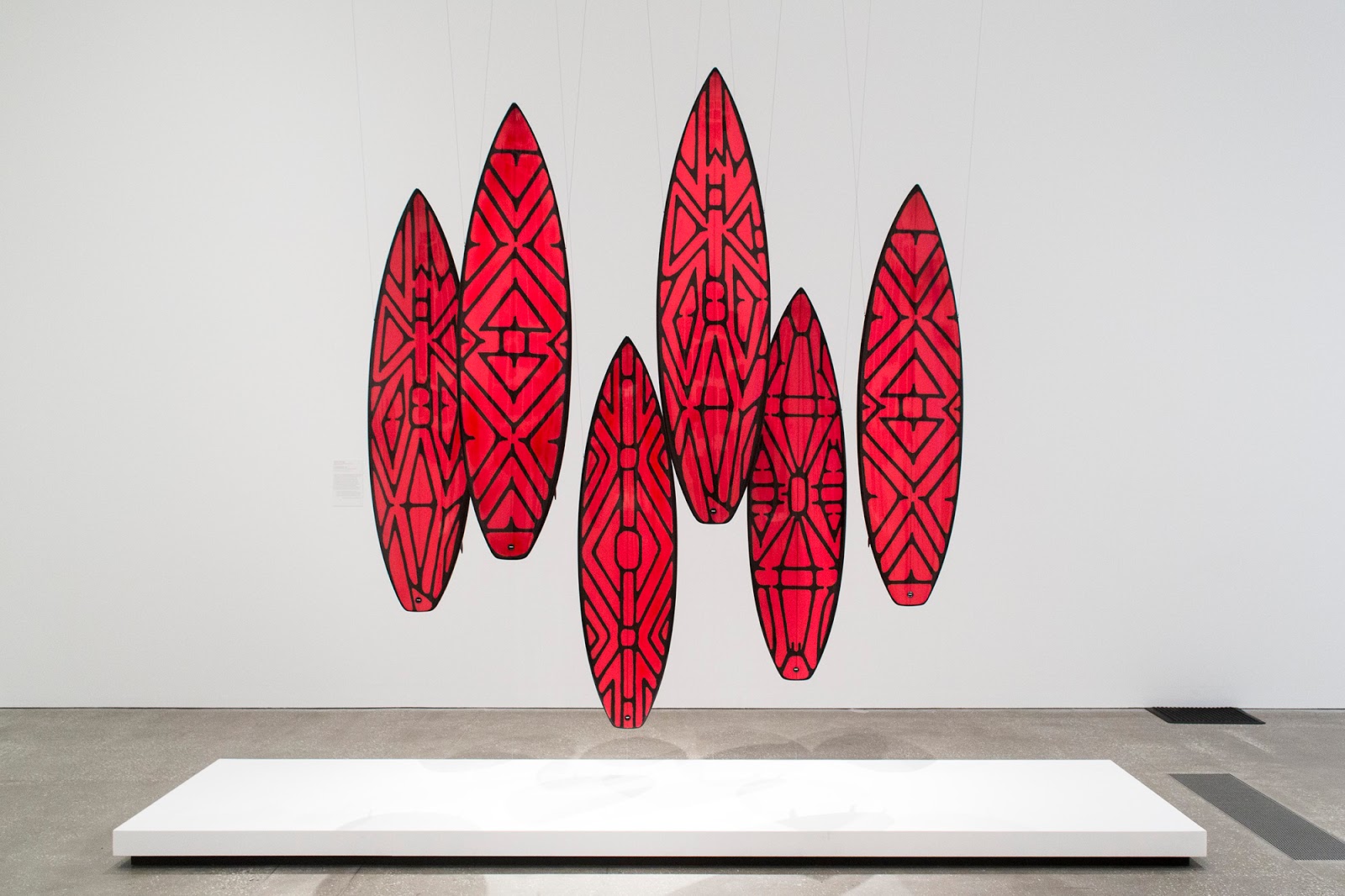
As a whole, APT8 has a great focus on the Pacific. There’s an abundance of oceanic art. Often, it’s in a contemporary style, with live tattooing, performance art and photography. But it’s all weaved together with traditional icons. Plus, on the opening weekend there were a few people in ethnic dress - often part of installations - wandering around the gallery.


Of course, there’s more at APT8 than a person can really absorb. But take time, it’s worth it.


23 August 2015

Contemporary Queensland Artists at GOMA Q: Spotlight on Sam Cranstoun


Words: Saskia Edwards
Images: Jonathan Rae

Lord Louis Mountbatten - the cousin of the Queen - was responsible for funding an affordable braille typewriter, developing a particular shade of pink and was a supporter of a military ship made from ice and wood pulp. 

Then, in 1979, he was assassinated by the IRA. They blew up a fishing boat he and was aboard off the coast of the Irish town Mullaghmore.

Sam Cranstoun remembers this quizzical and benevolent royal in his works at GOMA Q. 

“I came across this figure Mountbatten who was connected to the British royal family, but also connected to the Russian royal family.

“All of these little stories kept presenting themselves and they were just increasingly fascinating.

Perhaps Mountbatten was also motivated to think up these schemes by a desire to prove his relevance as a royal. It was an era where the divine rights of the monarchy were being questioned. Hence it’s possible that Mountbatten was attempting to justify his position through, somewhat misguided, ingenuity.

“He really was clearly striving to do good things. They were incredibly earnest.

“A lot of them were quite ridiculous and outlandish, but they were all really based in fascination with innovation, but also by having a military edge.”

Sam’s exploration of the Mountbatten narrative manifested itself in three ways. Firstly, a flag dipped in Mountbatten pink - a mauve hue he thought would be an effective camouflaging colour for the military (but was probably a bit too fabulous). Secondly, a canvas punched with braille. It reads “remember in spite of everything he was a great man”.

“There was a biographer that was writing the official Mountbatten biography and he did exhaustive research through his archives and work with him directly.

“And apparently Mount Batten had quite a flair for exaggerating his role in history.

“This biographer, his whole life was made exceedingly difficult by the fact that we would hear the story and find out the story from Mountbatten and then would have to perform more research to actually determine if that was actually true or not that was an incredibly frustrating for him.

“To the point where he actually made a plaque that was his own personal mantra that said, ‘remember in spite of everything he was a great man’.”

And finally, a film. Sam travelled to Mullaghmore, the site of Mountbatten’s murder, to trace his final days and examine the scar the event left on the town.

“It’s fair enough and it’s justifiable and understandable that they [the IRA] wanted their own country and that they wanted to take it back for themselves.

“But then the way they went about doing it was so morally bankrupt it was so wrong, the way that they would kill innocent people just to bring attention to their cause.”

“I was interested in how my relationship with the story would actually change by visiting Mullahgmore.

“One of the things that I thought would be an interesting activity while I was there was to actually go out in a boat and see the waters that he would have seen everyday and seen while he was killed.”

The video is quite soft and placid - it follows the rolling landscape of Mullaghmore - that is often interrupted by the monolithic Classiebawn Castle. And there always seems to be a faint serene wind. But it’s like the town has a thin film of serenity enveloping a much greater turmoil.

Sam contacted a charter boat company about taking a trip around the idyllic peninsula. They couldn’t take him, but the operator actually knew Mountbatten. In fact, she maintained his boat for a decade and was familiar with him. Sam spoke to her over two days about the assassination, Mountbatten and how the event has shaped the town. It was, quite obviously, an emotionally charged issue for her - with her regularly breaking down during the interview.

“I was very aware that clearly this isn’t something that has just disappeared and it wasn’t just going to disappear – it was a story that was forever linked to the town.

“I knew it was something that preoccupied her quite a lot, but I didn’t expect her to be quite as emotional as she was.”

Sam’s series was quite sombre. But simultaneously quite meditative. It shows, through a very specific window, how one person can become the epicentre of so many peripheral issues (modern royalty, the War of Independence, the military). And it shows how the waves of one person’s life have carved permanent grooves in many people’s minds. 

Here's some of the other works by contemporary Queensland artists on show at GOMA Q.


30 April 2015

Michael Parekowhai: The Promised Land at GOMA


Words: Saskia Edwards
Images: Jonathan Rae

What is the promised land?

It’s that milk and honey elysium. That prophesied paradise. And it’s something that’s written into our history, mythology and self perception.

You’ll find it at the end of 40 years of walking, at the end of the world, at the end of your life or in a new city, a new country, a new person. 

Over the last 26 years of practice Michael Parekowhai has navigated his way through through this idea and how deeply it streams through our sense of identity.

Maud Page is the Deputy Director of Collections and Exhibitions at GOMA and curator of Michael’s current exhibition there ‘The Promised Land’.

“You can look at that [the promised land] historically, you can look at it in terms of political terms now and there’s a lot of that kind of talk happening in political campaigns.

“But essentially, the promised land, because it looks back at history, it really is the way we might also remember our collective history and remember where we’ve come from.

“So for New Zealand and Australia that might encompass someone as famous and known as Captain Cook.”

And Captain Cook certainly acts as a centre piece for the exhibition. A three-metre tall stainless steel Cook sits in the middle of a room. The sculpture reflects the objects on the walls and as an observer, an image of yourself; distorted and warped in his own shape. And it forces the onlooker to meditate on how interwoven this person is with our own identities and perhaps, with a solemn look on Cook’s face, the reality of what attaining the promised land means.

Maud says through this piece Michael is “looking back at history and making a bit of a comment as to how we commemorate and what we commemorate and then looking at the ways we as individuals might be able to position ourselves in that history”.

Scale plays an integral role in the impact of Michael’s work. The sizes he chooses are no accident, they’re perfectly conceived to have the most impact.

“When you’re near it [the statue of Captain Cook], he’s sitting down, so you’re near it you’re almost awed by it but it’s not quite tall enough to be awed,” says Maud.

“And it’s not quite small enough for it to be an intimate relationship.

“So he just finds that exact middle ground.”

As you walk through the exhibition, Michael’s use of blank space is also apparent. He can make you feel like you’re compressed or claustrophobic walking through tight spaces or in a wide, open almost isolating expanse.

“He loves the sense that how we might breathe within the gallery, how we might physically encounter artworks and the effect that that scale has on us,” says Maud.

“So instead of being in his practice previously at a human scale, he might bring them right down to maquette size and create a completely different feeling.

“Or he might upsize some of the things that we’ve only ever seen very very small, like the small Cuisenaire rods that were used to teach kids or to teach Maori language in the late 70s and early 80s.”

Michael’s sculptures are also laced with a kind of humour - a sarcastic wit. You can see it in his elephant, tipped on its head, a seal holding up a piano and giant pick-up sticks at the foot of a ballerina.

“He is looking at colonialism, he is looking at social issues such as the employment of Maori people or the position of say Maori battalions in WWI and when they came back from the trenches back into New Zealand, what happened to them,” says Maud.

“So they’re things that are extremely visceral and very contested and the way that he brings humour into them means that he can actually make a comment on them, but also not appear too didactic, which is something that I particularly love in his practice.”


Through his shiny, playful and at times confronting sculpture Michael invites us to think about our sense of self and how that’s inseparably linked to the legend of the Promised Land.


20 March 2015

A view from David Lynch: Between Two Worlds exhibition at GOMA and talk at QPAC


Words: Saskia Edwards
Images: Jonathan Rae
Artwork: David Lynch

David Lynch sits on a cubic leather chair across from another David, David Stratton.

And in QPAC’s Concert Hall it seems fittingly bizarre and cinematic.

Giant copper-coloured organ pipes hang over the two greats of film and the stage is dressed for a performance by the Queensland Symphony Orchestra (or as David Stratton accidentally called it ‘the Queensland Sympathy Orchestra’).

Their bodies are a complete contrast. David Stratton sits back languidly with his legs crossed (exposing his socks) while Lynch hunches forward and rests his elbows on the arms of the chair, holding his microphone in two hands.

David Lynch looks almost exactly like I expected, if not a little shorter and softer: a tsunami-like quiff sits on his head like a tuft on an exotic bird. And he wears a black suit with a slim tie - his collar a little skew-whiff.

The audience is coated in red light, somewhat like the red room.

And of course, the crowd is littered with Lynch diehards who have come to congregate in the presence of their strange deity. They’re all dressed in their most eccentric outfits - some channelling Audrey Horne, others Henry Spencer. 

Lynch begins by talking about ideas - something he brings up a lot. You come to realise obscure ideas like “a dead girl”, “a severed ear” and a “moving painting” are the premises for some of his greatest works.

“The best thing in the world is ideas,” says Lynch.

“None of us do anything without an idea - even if you look in the cupboard and there’s no coffee, you get an idea to go to the store and get some coffee.

“So there’s ideas for everything. And I love to try to take ideas and catch an idea that I fall in love with. And then I know exactly what to do.

“Stay true to that idea and translate it to one medium or another.”

When Lynch is answering he looks almost pained. His eyes are tightly closed, his brow furrowed, like he’s trying to conjure an image of what he’s saying in his mind. It’s the way you would if you had to describe someone in a facial composite. And at times he grasps his right hand in front of him when he talks as if he’s trying to hold onto a concept or grope his way around its silhouette.

Stratton goes on to ask Lynch about his transcendental meditation practice.

“Each of everyone of us human beings has I feel within us a treasury within us,” he says.

“This treasury is known by many names, but it’s like an ocean of pure consciousness - pure bliss. Unbounded, this field is. Unbounded, infinitive, eternal, immutable, immortal consciousness...

“Within everyone of us is unbounded intelligence, unbounded creativity, bliss, happiness, love, energy and peace.”

And David Lynch’s intonation is almost meditative itself as he speaks in a distinct fluid phrasing. His voice is somewhere between John Wayne and Stan Lee.

The talk is dotted with little intimate insights into Lynch’s career. Like the time Mel Brooks was given the script for ‘The Elephant Man’.

“Fate plays a huge role in our lives. No one would believe that someone would pick me and Eraserhead to do a Victorian drama...

“Mel is a very interesting fellow and he’s an abstract thinker.

“He loved it [The Elephant Man script] and he said, ‘you’re in you’re in you’re in and who is this David Lynch?’

“And they said ‘Mel, you’ve got to see Eraserhead’ and so I said, ‘Listen guys, it’s been great knowing you’.

“So Mel watched it and after the screening they made me come to his room...

“And the doors burst open and Mel was running toward me and embracing me and said, ‘I love you, you’re a mad man’.”

Then there was this anecdote about dancing with Federico Fellini’s wife Giulietta Masina at the premier of ‘Blue Velvet’.

“I got to dance with Giulietta Masina on opening night in Montreal.

“We opened the dancing of this party, dancing together, it was so beautiful, such a beautiful soul she was.

“Imagine that.” 

Some of Lynch’s answers are less formed. Kind of like a stream of consciousness that no one else really understands. At the end of a lot of the responses David Stratton pauses, seemingly thinking, ‘Is that it?’.

But a there's a little bit of sadness for Twin Peaks fans; Lynch can’t confirm a new season. He say he’d been writing the script for four years and had been in contract negotiations for a year, but nothing had been finalised.

An arc of David Lynch’s talk is that he refused to comment on the meaning of his work. Like every viewer had to bring their own interpretation of the pieces and he wouldn’t interfere with that perspective.

But he also spoke about what it’s like to complete a project.

“Nothing is ever really perfect, but it’s finished and it feels complete and then there’s a very good feeling and it opens the door to the future.

“Until a thing is finished, you can’t really think to much about other things. So when a thing is finished a door is opened and you start thinking about new things.”

In the end, I left the talk with ideas whirring in my head; animated by David Lynch’s mysterious and complicated imagination. 


Perhaps it’s much like the maestro’s movies, and unlike the gel-capsule-coated films of Hollywood; you can never really walk away from a David Lynch.


8 December 2014

Future Beauty at GOMA: From Kimono to Kawaii

 
Words: Saskia Edwards
Images: Supplied where specified, when not specified; Jonathan Rae.


It’s not new to remark on the coexistence of the traditional and the progressive in Japan.

In fact, you could say that is what defines much of the country’s cultural identity.

It’s a place where it is as common to see Cosplay as it is a Kimono.

The synergy of this dualism is no more evident than in fashion.

Every young designer has a love affair with Rei Kawakubo, who manages to combine the tradition of fine craftsmanship while effortlessly expanding the boundaries of design. 

At GOMA’s Future Beauty exhibition this concept is explored through a curation of 30 years of Japanese fashion.

“And really at the core of the exhibition is this balance between tradition and innovation, so you have this really strong sense of a unique Japanese sensibility but also cutting edge technology and remaining at the avant-garde,” says Associate Curator, Asian Art Tarun Nagesh.

“To really suggest these broader ideas of art and culture and even architecture where there is a strong sense in Japan of tradition.

“But really around the world everyone looks to Japan for technology and being highly advanced and experimenting with materials.”

The evolution of Japanese fashion is explored in the exhibition through four main themes: In praise of shadows, tradition and innovation, cool Japan and designers.

It begins with the inception of modern Japanese design when Rei Kawakubo and Yohji Yamamoto debuted their first collections in the early 1980s. 

Tarun says the collections were a stark contrast to the entrenched western aesthetic.

“It was so radically different to what other European designers were doing at the time.

“It really shows how Japanese designers have continued to be really innovative over the last few decades, bringing whole new concepts and new approaches to fashion design.”

Throughout the displays it’s evident that Japanese designers instinctively intermingle art and fashion - where silhouettes, prints and materials (and the treatment of materials) have the same quality as contemporary art.

In fact, a display of Japanese art accompanies the exhibition. Some of the designers spill over into the artistic wold, while other works compliment the garment design.

Whether it’s Koji Tatsuno dramatic ensembles, Rei Kawakubo’s oversized structures or Junya Watanabe’s stark use of colour, Japanese designers seem to approach fashion more with an innovative concept in mind rather than pandering to idealised sensibilities about beauty.

And this idea isn’t going away. Future Beauty also showcases emerging designers.

“In the exhibition there’s quite a few younger labels that cater to a specific sub-culture or draw from a specific influence that really shows the broader sub-cultures emerging in Japan,” says Tarun.

“So some relate to Manga and anime and some more to a Lolita look or a Kawaii look, you know the idea of the cute and the Cosplay.

“But there’s all these labels that have kind of emerged and become cult figures for very specific niche audiences, which I think are really fascinating.”

The exhibition is travelling, beginning in 2011. Tarun says Brisbane is the last leg of the tour.

 “So we’ve kind of got the most updated version, which includes labels that have only emerged in the last couple of years as well as there’s some really recent collections. 

“There’s some really recent collections there’s even 2014 collections from Rei Kawakubo.”


What’s the future of Japanese design? Well, with the country still pushing fashion progression along with the expanding abilities of technology, it’s hard to determine. But what will always remain true to Japan is its deeply ingrained and widely renowned sense of tradition.

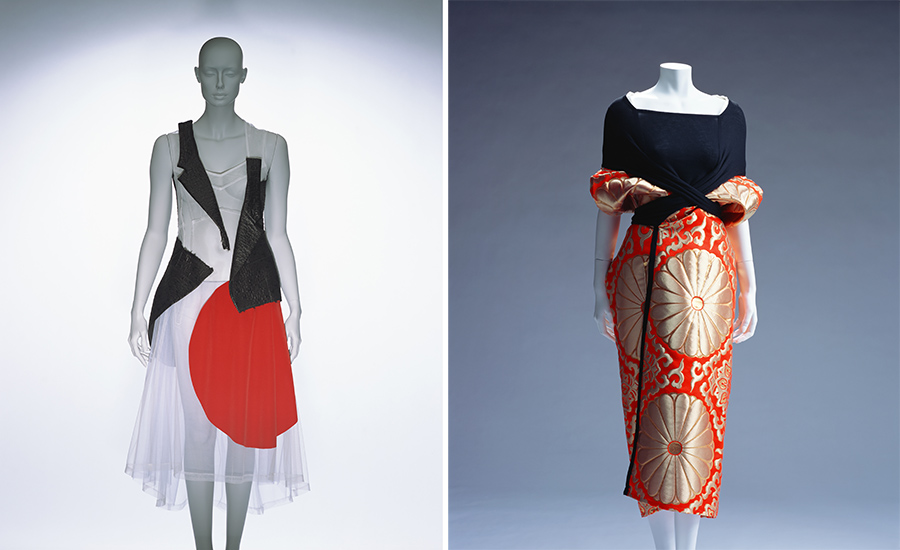
Above Image: As supplied by GOMA. Left: Undercover (Jun Takahashi) / Spring/Summer 2006 / Collection: Kyoto Costume Institute / Photograph: Masayuki Hayashi ) Right: Junya Watanabe Comme des Garçons / Autumn/Winter 2009–10 / Collection: Kyoto Costume Institute / Photograph: Masayuki Hayashi
Image: Sculpture work by Yayoi Kusama, on show at GOMA, at the same time as Future Beauty.


Image: As supplied by GOMA. Left and Right: Cool Japan Comme des Garçons (Rei Kawakubo ) / Spring/Summer 1997 / Collection: Kyoto Costume Institute / Photograph: Takashi Hatakeyama
Above: Japanese artwork on show at GOMA, at the same time as Future Beauty
Above: As Supplied by GOMA. Left: Junya Watanabe Comme des Garçons / Spring/Summer 2002 / Collection: Kyoto Costume Institute / Photograph: Takashi Hatakeyama Right: Junya Watanabe Comme des Garçons / Autumn/Winter 2000 – 01 / Collection: Kyoto Costume Institute / Photograph: Takashi Hatakeyama
Above: Japanese artwork on show at GOMA at the same time as Future Beauty. 
Above: As Supplied by GOMA. Left: Comme des Garçons (Rei Kawakubo) / Spring/Summer 2007 / Collection: Kyoto Costume Institute / Photograph: Taishi Hirokawa Right:Yohji Yamamoto / Spring/Summer 1995 / Collection: Kyoto Costume Institute / Photograph: Takashi Hatakeyama

19 July 2014

Harvest at GOMA; food for eyes


Words: Saskia Edwards
Images: Jonathan Rae

Food is often considered only within the parameters of eating.

But food extends far beyond the single sense of taste.

Harvest reveals food’s experiential scope from seeing, hearing to touch.

Harvest includes more than 150 works from the gallery’s collection from seventeenth century oil painting to new installation acquisitions by Tomás Saraceno.

The exhibition includes video installation, still-life painting, sculpture, film and photography.

Within these forms it is evident that food is entrenched with symbolism, history and connotations.

Works within the exhibition explore the ideas of wealth, global food trade, food production and distribution and native delicacies.

For example, Shirana Shahbazi’s Still life: Coconut and other things manages to combine seventeenth century aesthetics with contemporary themes. The image contains lush glossy tropical fruits.

It seems to be a reference to colonial prosperity where food from Africa, Asia and the Americas in art served to represent affluence and the conquering of the world. It evokes a sense of pride in our superiority. And it makes the thought linger: are we still victors over nations struggling under poverty and destitution?

Of course the exhibition culminates at the gallery restaurant. And there food is presented in its most obvious manifestation, as a dish.


But after witnessing food in so many different forms, it seems almost underwhelming to eat. Almost too temporal given the vast nature of the subject.


1 June 2014

Music and Art at GOMA’s Seen + Heard exhibition


Words: Saskia Edwards
Images: Jonathan Rae

Music and visual art have been widely inseparable since their inception. In fact, the etymology of music is muses, the nine goddesses of art and science.

The works in Seen + Heard fuse together popular culture, music, sound and visual art through sound installations, vinyl and musical scores.

Overarching Seen + Heard is the exploration of the symbolism of LP covers as an artistic representation of music. In a world that largely consumes intangible music, the exhibition strives to expose the now somewhat obsolete craft of an LP cover.

The exhibition includes more than 100 LP covers that trace the evolution of the 31.5cm x 31.5cm format. Recognisably it includes iconic designs like Andy Warhol’s Velvet Underground works and Joy Division’s Unknown Pleasures.


Perhaps the exhibition suggests the necessity of both forms to enhance each other; that you cannot fully see something until you hear it and you cannot fully hear something until you’ve seen it.