Showing posts with label modern art. Show all posts

18 January 2016

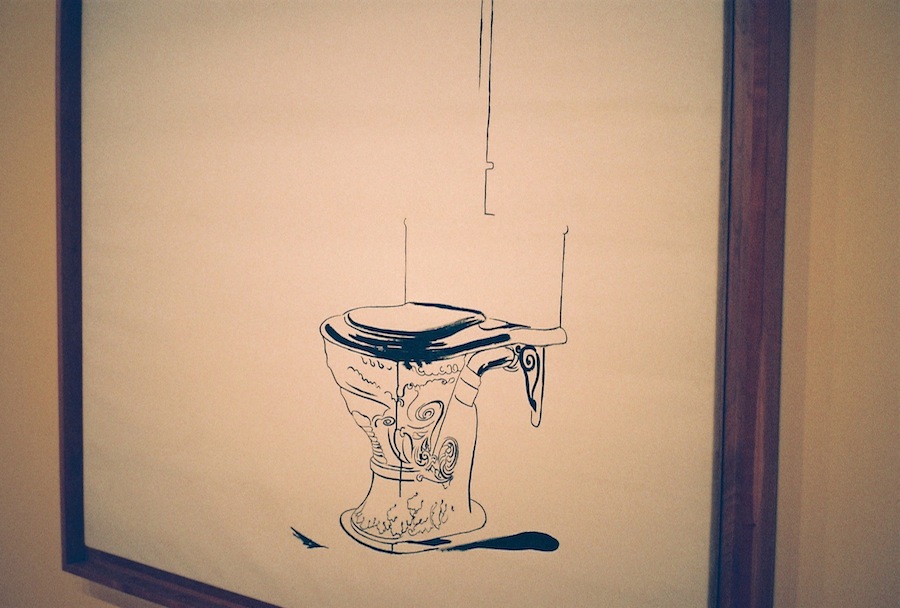
Andy Warhol and Ai Weiwei at National Gallery Victoria


Words/Images (35mm film): Saskia Edwards

There’s something kind of overwhelming about being in the presence of great artwork – that pangs you in the sternum and shortens your breath. You know that you’re looking at something that some exceptional person, who really sees things, created. That’s certainly true of Ai Weiwei and Andy Warhol at the National Gallery of Victoria. In a way, it’s oppressive because you want to absorb it and appreciate it all.

However, this is probably truer of Ai Weiwei’s works. Of course, Andy Warhol’s commentary on consumerism is strengthened by the fact that his own works were mass produced. But once you’ve seen his same pieces three, four, five times, it doesn’t feel very interesting. It’s kind of like taking a photo in front of the Eiffel Tower. In comparison, Ai Weiwei’s skill and aesthetic is much more intriguing. Plus it’s imbued with the political activism that Weiwei is known for. Overall, Weiwei’s works are much more dynamic and compel contemplation in a way that Warhol’s no longer do.

Throughout the exhibition, it’s hard not to question why these two artists were put together.  There are seemingly obvious, but meaningless, links – both artists look at Mao, flowers or mug shots. There doesn’t really feel like a point to the pairing. Sometimes it’s interesting to see the contrast between their treatments of a subject. However, I don’t think either artist enhanced each other.

What I think I took away from the exhibition was a greater appreciation for Weiwei. You really get the sense that he’s a great artist. His work shows his broad range of interests (sculpture, photography, painting), his clever approach and his cunning examination of China’s politics and culture. But more than that, he’s brave. Ai Weiwei is brave in a way that Andy Warhol never was. He stands chest ballooned against one of the most authoritarian governments in the world and his work doesn’t bow to the trends of the art world. If you walk away with anything from this exhibition, it’s the understanding of the unrelenting and humble fearlessness of Ai Weiwei. Yeah, that’s bravery.


9 December 2015

Slavs and Tatars' 'Mirrors for Princes' at the Institute of Modern Art


Words: Saskia Edwards
Images: Jonathan Rae

When you walk into the ‘Mirrors for Princes’ exhibition by the art collective Slavs and Tatars you’re surrounded by a cacophony of voices. There are six different languages marbling together, including the Aboriginal language Yuggera. They’re coming from mirrored speakers dispersed around a luxuriously carpeted room. In fact, the voices are reading the Kutadgu Bilig, written in the 11th century by a Turkic author. It’s a part of medieval literature and a form called ‘mirrors for princes’. Apparently, they can best be described as self-help books for incoming royals. But the texts still raise issues relevant today - including the separation of church and state.

The second part of the exhibition is a dark surreal room with evocative luminous sculptures: glass tongues, long blonde hair, combs. It’s meant to be a comment on the concern around grooming expressed in the ‘mirrors for princes’. And it does create an unsettling feeling of intimacy and fetishisation.

The Slavs and Tatars collective is interesting in itself. They fuse together world cultures, particularly European and Asian areas. They started out nearly a decade ago. Since then, they’ve produced exhibitions, books and lecture performances everywhere from MoMA to the Pompidou. 


Enough talk, take a look:


7 September 2015

Robert MacPherson 'The Painter's Reach' at GOMA


Words: Saskia Edwards
Images: Jonathan Rae

At times while walking through Robert MacPherson’s ‘The Painter’s Reach’ show, you feel like you could be at your local grocer, or driving through a small town somewhere like the Granite Belt. 

The exhibition revels in the everyday. There’re signs with mundane and sometimes surreal messages splashed onto them - always in the bold, imposing and rusticated style of MacPherson. Many of the works have a dry, rough feeling about them, much like the nature of processed wood and some of Australia’s landscape. And objects of everyday life are celebrated like benches, shirts, dry cleaning.

More than 40 years of MacPherson’s career is explored in this retrospective. It looks at his process, obsession with the medium of paint and social commentary. That includes a reflection on the history of “miracle drug” M & B 693 to treat gonorrhoea.


But throughout Robert MacPherson’s works there seems to be something inherently, and evocatively Australian. Each of his works conjure up a memory, understanding and distinct feeling of what Australian life is.


30 April 2015

Michael Parekowhai: The Promised Land at GOMA


Words: Saskia Edwards
Images: Jonathan Rae

What is the promised land?

It’s that milk and honey elysium. That prophesied paradise. And it’s something that’s written into our history, mythology and self perception.

You’ll find it at the end of 40 years of walking, at the end of the world, at the end of your life or in a new city, a new country, a new person. 

Over the last 26 years of practice Michael Parekowhai has navigated his way through through this idea and how deeply it streams through our sense of identity.

Maud Page is the Deputy Director of Collections and Exhibitions at GOMA and curator of Michael’s current exhibition there ‘The Promised Land’.

“You can look at that [the promised land] historically, you can look at it in terms of political terms now and there’s a lot of that kind of talk happening in political campaigns.

“But essentially, the promised land, because it looks back at history, it really is the way we might also remember our collective history and remember where we’ve come from.

“So for New Zealand and Australia that might encompass someone as famous and known as Captain Cook.”

And Captain Cook certainly acts as a centre piece for the exhibition. A three-metre tall stainless steel Cook sits in the middle of a room. The sculpture reflects the objects on the walls and as an observer, an image of yourself; distorted and warped in his own shape. And it forces the onlooker to meditate on how interwoven this person is with our own identities and perhaps, with a solemn look on Cook’s face, the reality of what attaining the promised land means.

Maud says through this piece Michael is “looking back at history and making a bit of a comment as to how we commemorate and what we commemorate and then looking at the ways we as individuals might be able to position ourselves in that history”.

Scale plays an integral role in the impact of Michael’s work. The sizes he chooses are no accident, they’re perfectly conceived to have the most impact.

“When you’re near it [the statue of Captain Cook], he’s sitting down, so you’re near it you’re almost awed by it but it’s not quite tall enough to be awed,” says Maud.

“And it’s not quite small enough for it to be an intimate relationship.

“So he just finds that exact middle ground.”

As you walk through the exhibition, Michael’s use of blank space is also apparent. He can make you feel like you’re compressed or claustrophobic walking through tight spaces or in a wide, open almost isolating expanse.

“He loves the sense that how we might breathe within the gallery, how we might physically encounter artworks and the effect that that scale has on us,” says Maud.

“So instead of being in his practice previously at a human scale, he might bring them right down to maquette size and create a completely different feeling.

“Or he might upsize some of the things that we’ve only ever seen very very small, like the small Cuisenaire rods that were used to teach kids or to teach Maori language in the late 70s and early 80s.”

Michael’s sculptures are also laced with a kind of humour - a sarcastic wit. You can see it in his elephant, tipped on its head, a seal holding up a piano and giant pick-up sticks at the foot of a ballerina.

“He is looking at colonialism, he is looking at social issues such as the employment of Maori people or the position of say Maori battalions in WWI and when they came back from the trenches back into New Zealand, what happened to them,” says Maud.

“So they’re things that are extremely visceral and very contested and the way that he brings humour into them means that he can actually make a comment on them, but also not appear too didactic, which is something that I particularly love in his practice.”


Through his shiny, playful and at times confronting sculpture Michael invites us to think about our sense of self and how that’s inseparably linked to the legend of the Promised Land.


2 July 2014

China’s reformations at White Rabbit Gallery


Words and images: Saskia Edwards

China’s modern history has been punctuated with reformations.

At the turn of the century, the Xinhai Revolution ended centuries of imperial rule in China. The Qing dynasty was overthrown by rebellion uprisings across the nation.

In 1949 Mao Zedong created the People’s Republic of China - a communist nation - an event that has ultimately shaped much of modern China. Mao’s legacy is one of ultimate control, indoctrination and force.

Mao’s successor Deng Xiaoping reformed China to a market economy, opening the nation to the rest of the world and infiltrating China with Western products and concepts.

Thus, in a century, China has seen its country in a flux of reformation and continual transformation.

The Reformation exhibition is explored through three levels – modern forms, sex and visual illusions.

The initial level is scattered with robotics and modern technologies. While the forms are decidedly new, the pervading ideas often stem back to ancient mythology or historical behaivour.

As viewers progress to the middle room, the concept of sex permeates the works. Sexual interaction in China, much like many societies, has followed a history of particular and obscure etiquettes. From the titillation of deformed feet, to the current one-child policy, sex in China has been shrouded in connotations of suppression, pure recreation and shame.

These themes are apparent in works like a sculpture constructed from bondage apparatus, video works of stylised sexual acts and anatomical photographs of body parts.

On the final level there is a focus on projections, optical illusions and a reshaping of traditional art. Oil paintings on canvas have been cut out and weaved into a chain of decapitated heads and wooden antique film apparatus projects video of historical photographs and footage.


Overall, the White Rabbit Gallery illuminates the spectrum of contemporary work by artists from China, a country better known for its traditional art forms. While freedom of expression is limited in the communist state, modern Chinese art is still prolific around the world.

A rabbit often symbolises rebirth, sexuality and innocence. And perhaps it is these concepts that underlie much of modern Chinese history and the work of current Chinese artists.

Visit the White Rabbit Gallery in Chippendale in Sydney.

(All photographs are taken on 35mm film)


21 June 2014

Greer Honeywill at QUT’s Wood exhibition

 
Words: Saskia Edwards
Images: Jonathan Rae

Street after street, the same house after the same house. Modern society has given life to a world of homogenous products with absolute, manufactured predictability. Nothing typifies this more than the housing estate; as if each house came in the same packaging.

Greer Honeywill’s the housing estate is not to scale #2 captures this monotonous zeitgeist. The work seems to look down from an aerial view over an estate and its super fractal precision.

Greer explains: “So that little piece, the optimism is, ‘It’s a housing estate, wow!’ Really good position, nice little houses.

“It’s not exactly to scale, but it’s a little bit like you’re buying off the plan, apartments in buildings, before they see it.

“Sometimes it’s extremely hard for people to visualise even in two dimensions, but visualise in three dimension.

“And so they’re often quite disappointed with what they end up with, because they imagined something completely different.”

The work is part of an exhibition at QUT Art Museum entitled Wood: Art Design Architecture. It aims to explore wood as medium in contemporary Australian art. The works range from wooden surfboards, luminous hollow tree trunks and artisanal furniture.

But permeating the whole exhibition was the wide spectrum of timber’s natural colours.

Greer’s piece varied in colour through raw wooden tones.

“I decided I wanted to have like a painter, a palate of colours, so I went off to the wood yard and spent a long time in the sample room.

“And eventually came out with three timbers, Huon pine, which is pale, American cherry wood and American redwood.

“So if you like, that was light medium and dark.

“So there was three distinct tones, which you actually see in that work.”

Wood is imbedded with symbolism: nature, progress, stability. It’s separated from its origin – trees – to represent something that is created. And in that sense wood is inherently about production. However, wood has endured centuries of use because of its beauty.

For Greer, the mere aesthetics of the wood are what attracts her to the medium.

“When you cut wood and you do not surface it, it is for me, unspeakably beautiful.

“So I don’t finish any of my works, they are raw, so that they can change over time.

“And I say that if a work sat in a room over time, it will change in response to the air that we breathe and the air we exhale, everything affects the timber.


“But the change is so slow that it’s kind of a metaphor for life and death.”


9 March 2014

Dord Burrough’s ‘Feelers’ exhibition and the psychedelic unknown


Words: Saskia Edwards
Photos: Jonathan Rae
Original Artwork: Dord Burrough

Objects and their functions no longer had any significance. All I perceived was perception itself, the hell of forms and figures devoid of human emotion and detached from the reality of my unreal environment. I was an instrument in a virtual world that constantly renewed its own meaningless image in a living world that was itself perceived outside of nature. And since the appearance of things was no longer definitive but limitless, this paradisiacal awareness freed me from the reality external to myself. The fire and the rose, as it were, became one.

That’s Federico Fellini describing a transcendental LSD experience.

Dord Burrough’s artworks trap you in this kind of psychedelic fantasy somewhere between a pastel Elysium and a hallucinatory nightmare. Dord says the delirium-like nature of her works is a representation of her life experiences.

“Those psychedelic experiences have an influence on the outcome.

“Those visual stimulus that one might experience that must have an effect on the way that I look at the world and paint.

“It’s sort of aesthetically comes out because that is an inspiration.”

Her current series ‘Feelers’ explores the external elements beyond temporal existence and the inherent spiritual potential in everyone.

“Whether they’re extensions of ourselves like auras and things like that but also of our environment,” Dord says.

“It’s about those non-physical element of ourselves and definitely spiritual elements to the works and I sort of think about our relationship with the spiritual in the current social context.”

Through the guise of her ethereal and almost tactile works, Dord explores the relationship between the spiritual and modernity. She says society is often left with a disconnected relationship with the mystical elements of life.

“On any level, Western culture isn’t left with those traditions that help us connect with each other and connect with our spiritual self, which I think is something makes it more difficult anxieties and things that are a big problem in our society.”

Dord graduated a Bachelor of Fine Arts degree at QCA in 2008. Since then she’s lived, worked and exhibited in Berlin and currently lives between Brisbane and Byron Bay. She says her artistic style has been infiltrated with these travels.

“It’s really about life experiences and things that you draw from those experiences come out in the works.”

Dord’s artworks force introspection. It confronts the viewer with the metaphysical possibilities within us all and our fearful dislocation with the mystical.


The exhibition is on at Ryan Renshaw Gallery until April 5th.