27 January 2016
18 January 2016
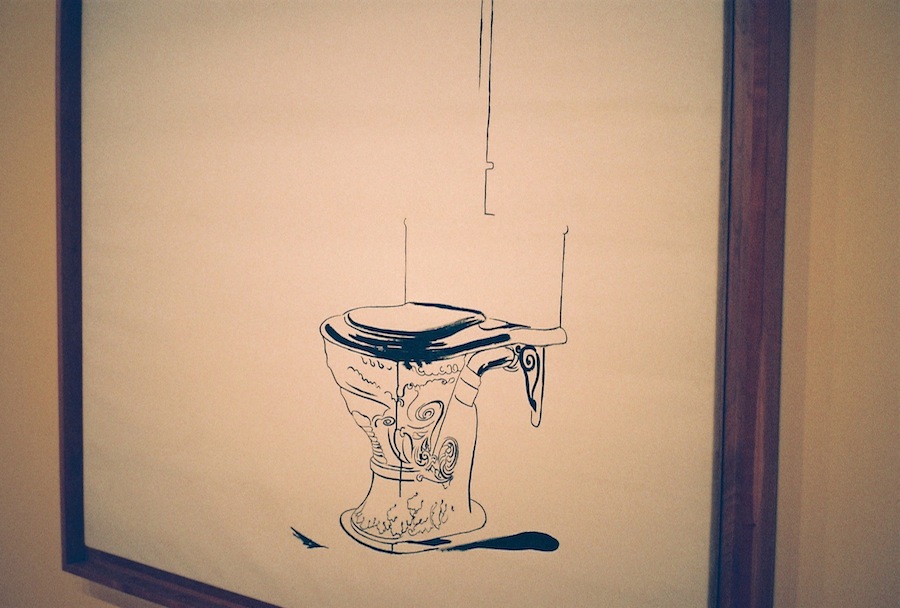
Andy Warhol and Ai Weiwei at National Gallery Victoria
Words/Images (35mm film): Saskia Edwards
There’s something kind of overwhelming about being in the
presence of great artwork – that pangs you in the sternum and shortens your
breath. You know that you’re looking at something that some exceptional person,
who really sees things, created. That’s certainly true of Ai Weiwei and Andy
Warhol at the National Gallery of Victoria. In a way, it’s oppressive because
you want to absorb it and appreciate it all.
However, this is probably truer of Ai Weiwei’s works. Of course,
Andy Warhol’s commentary on consumerism is strengthened by the fact that his
own works were mass produced. But once you’ve seen his same pieces three, four,
five times, it doesn’t feel very interesting. It’s kind of like taking a photo
in front of the Eiffel Tower. In comparison, Ai Weiwei’s skill and aesthetic is
much more intriguing. Plus it’s imbued with the political activism that Weiwei
is known for. Overall, Weiwei’s works are much more dynamic and compel
contemplation in a way that Warhol’s no longer do.
Throughout the exhibition, it’s hard not to question why
these two artists were put together. There are seemingly obvious, but meaningless, links
– both artists look at Mao, flowers or mug shots. There doesn’t really feel
like a point to the pairing. Sometimes it’s interesting to see the contrast
between their treatments of a subject. However, I don’t think either artist
enhanced each other.
What I think I took away from the exhibition was a greater
appreciation for Weiwei. You really get the sense that he’s a great artist. His work shows his broad range of interests (sculpture, photography, painting), his
clever approach and his cunning examination of China’s politics and culture.
But more than that, he’s brave. Ai Weiwei is brave in a way that Andy Warhol
never was. He stands chest ballooned against one of the most authoritarian
governments in the world and his work doesn’t bow to the trends of the art
world. If you walk away with anything from this exhibition, it’s the
understanding of the unrelenting and humble fearlessness of Ai Weiwei. Yeah,
that’s bravery.
19 December 2015
Julian Meagher 'Alone in the Sun' at Edwina Corlette Gallery
Images: Jonathan Rae
I think everyone has had a moment where they become conscious, and feel very acutely, that they are a product of their parents. Maybe it’s your same fear of cats as your mother, or that you like your toast slightly burnt like your father, or that you’ll always vote Labor because they told you that’s what’s right.
But more than these obvious, more tangible things, your parents can deeply and permanently instil in you your values, opinions and beliefs. And it’s only when you're spraying your neighbour’s Tabby with your garden hose do you realise it.
But what about their parents? And your parents’ parents’ parents? How has that influenced you?
Well, that’s what painter Julian Meagher is looking at.
“I think we can all see traits of ourselves in our mum and dad and, then I’m looking at further, well they’ve obviously got their parents in them as well,” he told me.
“We all must inherit something and as a nation, we have these shared traits as well - our love of drinking, our love of the beach, our identity, what makes us who we are?
“And I think as you get older, you start to look back and ask, ‘Why am I, who I am? Why do I have these values? And why do I react in these ways?’”
The hero piece of this series, ‘Alone In The Sun’, is a shadowy image of a group of turn-of-the-century women. They pose for a photo in an austere style with seemingly transparent faces. It has the same feeling as Jane Campion’s ‘The Piano’. It’s eerie and also distant. These women are Julian’s ancestors.
“I was at christmas dinner and I looked at the wall and there was the really powerful ghost-like image of these women from the early 1900s and I said, ‘who’s this?’, and she [Julian’s mother] said, ‘It’s your great-great grandma who lived out in the bush’.
“I’d never seen this image and they were so ghostly, it was such a powerful image.”
Julian also looks specifically at the relationship between drinking in Australia and our ancestry.
“I started looking at broader things around masculinity and Australian identity years ago with drinking culture and things because I like painting bottles.”
In this series there are paintings of bottles, some fallen, others acting as vases for native Australian flowers. They are symbols for our uniquely Australian relationship with alcohol.
“In other countries, for example in Italy, if you get too drunk, you dishonour the family, in Australia the more drunk you get, the more honour you bring.
“Our Prime Minister holds the record for sculling a beer, our famous cricketer David Boon holds the record for drinking 52 tinnies on a flight to London. They’re our heroes.
“It’s very engrained in our culture because Australia’s very isolated, it’s all about how tough you are, how stoic you are.”
It’s worth noting here, that Julian hasn’t always been an artist. In fact, he’s still a registered doctor.
“The switch is easy, having a career as an artist is the hard part.
“I think it’s way harder to be an artist than to be a doctor to be honest.
“To keep creating the works, it’s such an unstable career. Art is very difficult financially, particularly in early years and it’s a very, very tough road and it’s quite a solitary thing.”
His works are influenced by his medical career. His painting is very clinical. He’s “no wild, crazy artist”. And it is evident in his clean, precise works, that really do examine history, drinking and identity.
9 December 2015
Slavs and Tatars' 'Mirrors for Princes' at the Institute of Modern Art
Words: Saskia Edwards
Images: Jonathan Rae
When you walk into the ‘Mirrors for Princes’ exhibition by the art collective Slavs and Tatars you’re surrounded by a cacophony of voices. There are six different languages marbling together, including the Aboriginal language Yuggera. They’re coming from mirrored speakers dispersed around a luxuriously carpeted room. In fact, the voices are reading the Kutadgu Bilig, written in the 11th century by a Turkic author. It’s a part of medieval literature and a form called ‘mirrors for princes’. Apparently, they can best be described as self-help books for incoming royals. But the texts still raise issues relevant today - including the separation of church and state.
The second part of the exhibition is a dark surreal room with evocative luminous sculptures: glass tongues, long blonde hair, combs. It’s meant to be a comment on the concern around grooming expressed in the ‘mirrors for princes’. And it does create an unsettling feeling of intimacy and fetishisation.
The Slavs and Tatars collective is interesting in itself. They fuse together world cultures, particularly European and Asian areas. They started out nearly a decade ago. Since then, they’ve produced exhibitions, books and lecture performances everywhere from MoMA to the Pompidou.
Enough talk, take a look:
3 December 2015
QUT Fashion Graduate Show 2015 Muse//Refracted - Womenswear
Words: Saskia Edwards
Images: Jonathan Rae
How can I describe the QUT fashion graduate show? It’s a fairly unique event. Three years of working in such proximity has made an usually close university cohort. And all that work culminates in an event somewhere between a professional showcase and a school graduation. It’s exciting, but also tinged with sadness knowing that this is the end and now they’ll have to think about getting a job.
The show began with Lou Vicenzino’s monochromatic looks. From there it gradually transitioned from muted designs to more vivid pieces. That included Kat Walsh’s androgynous-Woody-Allen’s-Manhattan collection and Courtney McVicar’s pastel looks dripping in soft leather. It concluded with a splash of hot colour from Alice Waterhouse. So - in an effort to embrace the cheese-ball within me - the end still looks pretty bright.
LouiseVicenzo - Endless Second - Although Changed I Arise the Same
Alice Waterhouse - Rise//Run
26 November 2015
/APT8/ The 8th Asia Pacific Triennial at the Qld Gallery of Modern Art
Words: Saskia Edwards
Images: Jonathan Rae
“One thing that was really apparent to me and also very beautiful were the amount of saffron robes.
“It was almost as if the landscape was orange, that you couldn’t go to any parts of South East Asia without seeing this colour orange in your periphery and in your vision.”
That’s according to Cambodian-born American artist Anida Yoeu Ali, who’s described as one of the ‘rockstars’ of the APT8.
Her work at the exhibition centres on Cambodia as she takes on the persona of the Buddhist Bug.
Anida Yoeu Ali dresses as the Buddhist Bug in a long spiraling tube with feet sprouting out at its tail end. It’s somewhat Alice in Woderlandian - like the blue caterpillar. Of course, the fabric is that same vivid saffron that’s so evocative of Asia, Cambodia and Buddhism.
While being distinctly Buddhist, the bug also wears a sort-of hijab. As Anida says, it references the “Islam that my parents carried back to the U.S. with them that they preserved for me and then my rediscovery of Cambodian Buddhism”.
Anida left Cambodia when she was five years old. She lived through the Khmer Rouge, a period of Communist rule in Cambodia remembered for genocide. And this has resulted in dysphoria for Anida, with her life riddled with “war and the displacement and the refugee identity”.
However, Anida is not dwelling on the past.
“I felt this very palpable energy among my colleagues among the artist community in which there felt like a critical mass in which the artist community was finally addressing the present moment and not just locked in the time, in referencing the past, the past trauma.
“So to me it was a really exciting part and I knew we had something special that intersected with the reign of progress and modernisation and urbanisation that’s happening at a tremendous rate in Cambodia while the level of poverty increased.”
Beyond a performance piece dressed as the Buddhist Bug, Anida presented a film as part of the exhibition. It follows the bug for a night in Phnom Penh.
She begins at a carnival where the rides drench her in neon light. And then she rides around the busy streets of the city, her head poking through the roof of a took-took. She goes past a market and to a nightclub. There she finds young Cambodian women - some “empowered”, others not - dancing in mini skirts and tank tops with old white men.
All of this captures something very elemental and visceral about Cambodia. On one hand it seems to show the progression of Cambodia and how it has been thrust into the luminous modern world. But also it reveals how the nation is still growing. People are still largely on bikes and scooters. There’s an insidious invasion of Western culture. And, in a way, it still has that wild untamed beauty of Asia - where food is cooked on the side of the road, traffic is monstrous and anything could happen.
As a whole, APT8 has a great focus on the Pacific. There’s an abundance of oceanic art. Often, it’s in a contemporary style, with live tattooing, performance art and photography. But it’s all weaved together with traditional icons. Plus, on the opening weekend there were a few people in ethnic dress - often part of installations - wandering around the gallery.
Of course, there’s more at APT8 than a person can really absorb. But take time, it’s worth it.
19 November 2015
QUT Fashion Graduate Show 2015 - Menswear
Images: Jonathan Rae
Each year, the QUT Fine Arts Fashion cohort puts on a showcase of the students’ final year work. It’s the culmination of three years of dedication to pattern making, sewing and perhaps hearing the word ‘garment’ in the millions of times. Here’s a look at the menswear collections. It includes Elvrik’s signature boldly colourful looks emblazoned with his logo, ‘Global Citizen’ and, somewhat ironically, braille - given the visually vivid nature of his collection. While Aiden Renata took his cues from cowboys. His muted collection is somewhere between southern belle, La vache qui rit and Marques Almeida. And Tom Summers’ ‘404’ does kind of resemble a glitchy webpage. His fabrics look like a frozen screen in a subtle and beautiful way. Anyway, here’s all the menswear looks at the 2015 QUT Fashion Grad Show MUSE//REFRACTED.
Tom Summers '404'
Jordan Anderson - Elvrik 'Global Citizen'
Aidan Renata 'Full Cream'
Subscribe to:
Posts (Atom)